Equity Funds Attract a Surge of Money as Bond Funds’ Share Falls to 15%
- Input
- 2026-04-27 18:15:21
- Updated
- 2026-04-27 18:15:21
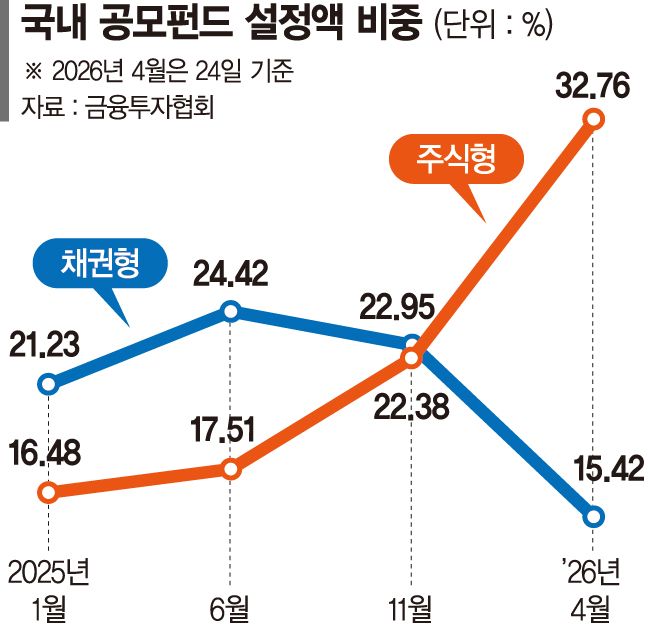
According to the Korea Financial Investment Association (KOFIA) on the 27th, the net asset value of domestic bond funds stood at 82.4036 trillion won as of the 24th, up only 943.5 billion won, or 1.16%, so far this month. By contrast, equity fund assets jumped 33.0286 trillion won, or 23.26%, over the same period to 175.0543 trillion won.
Net asset value refers to the principal investors have entrusted to the funds. In other words, most of the money investors put into funds this month went into equity products.
Equity funds now account for 32.76% of total public fund assets, widening the gap with bond funds, which make up 15.42%. At the start of the year, the figures were 24.90% for equity funds and 21.78% for bond funds, so the difference was much smaller.
At the beginning of January last year, bond funds led with a 20.92% share, ahead of equity funds at 16.57%. But as the stock market boomed, the share of equity funds rose sharply. By the end of November that year, the two were nearly level at around 22%, and in December equity funds overtook bond funds.
The shift is being attributed to rising expectations of an interest rate hike and weakening appetite for bonds amid a strong stock market. Bond prices and interest rates move in opposite directions. When market rates rise, the yield appeal of bonds already held by investors declines.
Cho Yong Gu, a researcher at Shinyoung Securities Co., Ltd., said, "Major developed economies will likely maintain a wait-and-see stance at their monetary policy meetings in the second quarter, choosing to observe the impact of the Middle East war more carefully before taking action." He added, "Many countries are expected to implement preemptive rate hikes at their next meetings to guard against broader inflation."
Yoon Yeo-sam, a researcher at Meritz Securities, also said, "If exports remain solid and investment rises led by semiconductor companies, growth could exceed our forecast of 2.6%." He added, "Stimulus that outpaces growth could even shift some supply-side price shocks into demand-side inflation pressure, making the two rate hikes the market is worried about a real possibility."
Meanwhile, inflows into the stock market are expected to accelerate further. Kim Du-eon, a researcher at Hana Securities Co., Ltd., said, "In the past, wealth in Korea was accumulated mainly through real estate, but now financial assets, especially stocks, are playing a larger role." He noted, "Capital may flow into the stock market not just through short-term rotation, but from the perspective of long-term asset allocation."
[email protected] Seo Min-ji Reporter