"Buying domestic pork is getting scary"... Pork import outlook hits record high
- Input
- 2026-04-27 18:15:19
- Updated
- 2026-04-27 18:15:19
Driven by the spread of disease... pork belly tops 2,600 won per 100 grams
According to Korea Agro-Fisheries & Food Trade Corporation (aT) on the 27th, the average price of domestic pork belly in April stood at 2,603 won per 100 grams, breaking the 2,600-won mark. That was up 117 won, or 4.7%, from 2,486 won a year earlier.
The main factors behind the sharp rise in domestic pork prices are the spread of livestock diseases and higher feed costs. Foot-and-mouth disease (FMD) broke out at pig farms for the first time in seven years last year, while 25 cases of African swine fever (ASF) were confirmed and the incidence of porcine reproductive and respiratory syndrome (PRRS) hit a record high. In particular, the influx of a new overseas strain of virus sharply increased disease damage and the number of animals culled.
Rising feed prices also played a part in pushing up pork prices. According to the Ministry of Agriculture, Food and Rural Affairs (MAFRA), the average feed price for livestock, including poultry and pigs, rose from 597 won per kilogram in November last year to 615 won in February, up 18 won, or 3.0%. Since feed costs typically account for 40% to 60% of livestock production costs, the added burden inevitably puts upward pressure on retail prices.
As domestic pork prices continue to climb, consumers and retailers are actively seeking imported pork. For example, Lotte Mart held a special promotion from Feb. 2 to 8, selling 300 tons of imported pork belly and shoulder at 990 won per 100 grams when paid with a promotional card, drawing a strong response from shoppers. Despite higher sea freight costs caused by conflict in the Middle East and a weak won, the retail price of imported pork stood at 1,488 won per 100 grams as of the 25th, about 40% cheaper than domestic pork.
Pork imports up 31%... Is domestic self-sufficiency under threat?
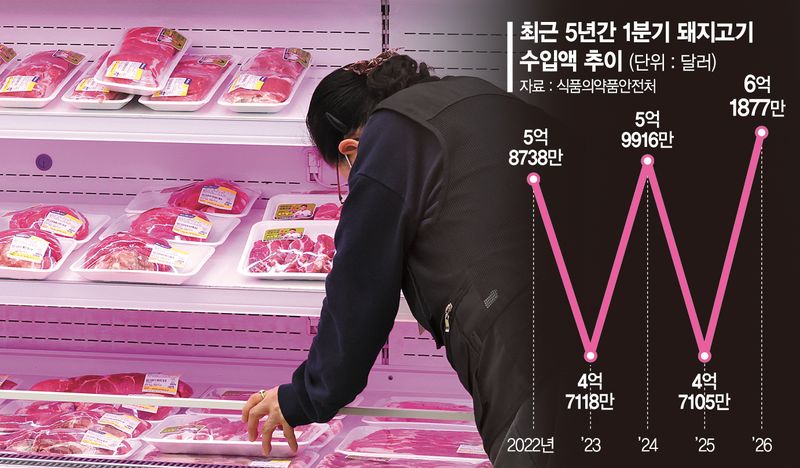
Backed by its price competitiveness, this year’s pork imports are expected to surpass all previous records. According to Korea International Trade Association (KITA) data, pork imports in January-March reached $618.77 million, up $147.72 million, or 31.4%, from $471.05 million a year earlier. Pork import values for the same period were $587.38 million in 2022, $471.18 million in 2023 and $599.16 million in 2024.
As the aggressive push by imported pork coincides with unstable domestic supply, the industry is increasingly concerned that the 70% self-sufficiency threshold for domestic pork could be broken.
An industry official said, "Defending a 70% self-sufficiency rate for domestic pork is considered one of the key indicators of food security." The official added, "To prevent a collapse in self-sufficiency, it is urgent to ease farmers’ production cost burden and establish preemptive quarantine measures to block the spread of disease."
security@fnnews.com Park Kyung-ho Reporter