Overheated High-Risk Leveraged Bets Prompt Securities Firms to Tighten Investment Access
- Input
- 2026-04-27 18:15:17
- Updated
- 2026-04-27 18:15:17
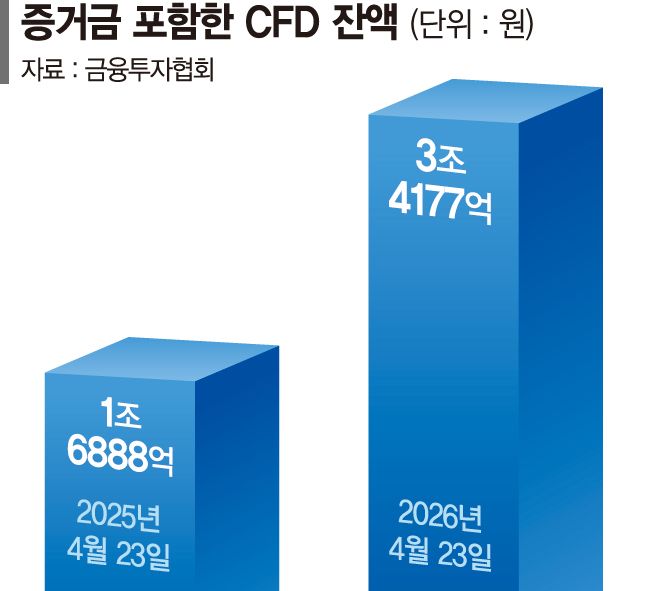
According to the financial investment industry on the 27th, CFD balances including margin deposits stood at 3.4177 trillion won as of the 23rd, the largest level on record. That is more than 420 billion won higher than the 2.9902 trillion won recorded at the start of the year. Compared with 1.6888 trillion won on April 23 last year, the figure has nearly doubled.
CFDs are high-risk leveraged products that settle only the difference in price movements without actually holding the underlying asset. They are mainly traded by professional investors, allowing large positions with relatively small margin deposits. Individual investors can also participate if they meet certain requirements. Even so, institutional investors still account for the overwhelming share of the market.
This year, CFD funds that had been concentrated in KOSDAQ have been moving quickly into large-cap KOSPI stocks. On January 2, CFD balances in the KOSPI Market stood at 1.1887 trillion won, below the 1.2393 trillion won in KOSDAQ. But as of the 23rd, KOSPI Market CFD balances had risen to 1.3633 trillion won, surpassing KOSDAQ's 764.3 billion won. CFD exposure to overseas investment has also increased rapidly. Balances jumped from 502.7 billion won on April 23 last year to 878.6 billion won at the start of this year, and reached 1.2944 trillion won on the 23rd.
In particular, CFD trading has surged around major semiconductor stocks. Samsung Electronics Co., Ltd.'s CFD balance rose from 40.3 billion won on January 2 to 162.8 billion won on the 23rd, while SK hynix Inc.'s balance increased from 70 billion won to 174.7 billion won over the same period. The continued rise in the KOSPI Composite Index appears to have drawn in institutional-style funds and high-net-worth investors as well. Market participants say aggressive bets using leverage are increasing, rather than simple spot purchases.
As concerns about overheating grow, securities firms are moving one after another to impose restrictions. KB Securities Co., Ltd. suspended new CFD purchases of SK hynix Inc. on the 21st, taking preemptive action to manage risk as CFD trading became overly concentrated in certain stocks.
Mirae Asset Securities Co., Ltd. also sharply raised margin requirements and adjusted stock classifications for some names, including Alteogen Inc., HYBE Co., Ltd., Kakao Corp., Korea Electric Power Corporation (KEPCO), POSCO Future M, Daeduck Electronics Co., Ltd., and G2Power Co., Ltd. Stocks classified as high risk are subject to restrictions on new margin lending and maturity extensions.
Mirae Asset Securities explained, "For stocks requiring 100% margin or classified as F-grade, new margin lending and maturity extensions are restricted," adding that the move is "a measure to protect investors and manage risk."
Toss Securities also raised margin requirements to 100% for stocks such as EcoPro HN Co., Ltd., Caregen Co., Ltd., Vitzrocell, and Green Resource. Kakao Pay Securities likewise suspended all new margin purchases, citing exhaustion of its credit line. While CFD inflows can add momentum to a rising market, there are also concerns that if volatility expands, forced liquidation of leveraged positions could amplify market shocks.
There is also growing concern that the sharp increase in CFD balances could pose risks not only to investors but also to securities firms. That is because if customers incur losses, brokers may have to shoulder the burden of hedging opposite positions and covering unpaid receivables. If a stock heavily concentrated in CFD trading were to plunge, a wave of forced selling could hit the market all at once, increasing losses for securities firms as well.
In fact, after the market crash triggered by Societe Generale Securities Korea in 2023, the securities industry significantly tightened its standards for managing CFD exposure.
[email protected] Kim Hyun-jung Reporter