Seven in 10 Jeonse Loans Last Year Were in the Seoul Metropolitan Area... Half of the Deposit for Seoul Apartments Rented by People in Their 30s Is Debt
- Input
- 2026-04-27 18:12:50
- Updated
- 2026-04-27 18:12:50
According to KB Real Estate on the 27th, an analysis of last year's KB jeonse loan data found that 73.7% of all loans were tied to jeonse contracts in the Seoul metropolitan area. By region, Gyeonggi Province accounted for 35.0%, Seoul for 31.1%, and Incheon Metropolitan City for 7.6%. In other words, two out of every three jeonse contracts that received loans were in the Seoul metropolitan area.
A KB Real Estate official said, "This means jeonse loans are concentrated in Seoul and Gyeonggi Province." The official added, "In Seoul, bank-funded loans accounted for 61.5%, while Buteumok Jeonse Loan made up 38.5%."
If the focus is limited to Seoul apartments, people in their 30s dominate jeonse borrowing. In 2025, they accounted for 52.9% of apartment jeonse loans, exceeding half of the total. They were followed by those in their 40s at 21.2% and those in their 20s at 11.5%.
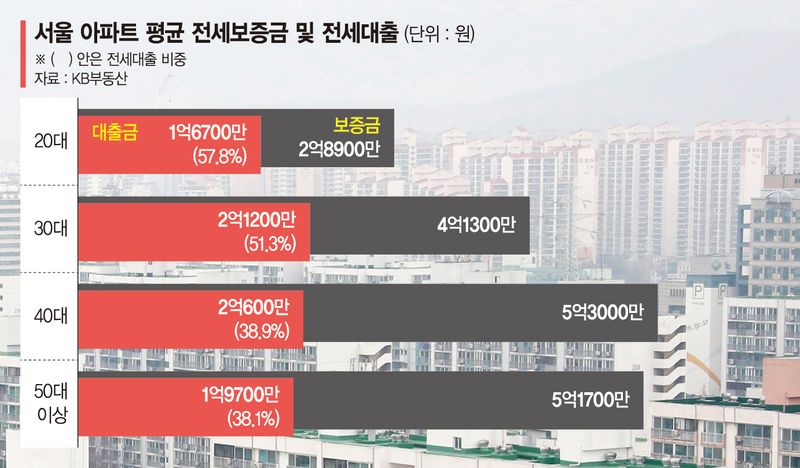
Looking at the average jeonse deposit and loan size for Seoul apartments by age group, people in their 20s and 30s are financing more than half of the deposit with loans.
By age group, the average jeonse deposit for apartments rented by people in their 20s was 289 million won. They borrowed an average of 167 million won, or 57.8% of the total. People in their 30s also rented homes with loans, borrowing 212 million won on average, or 51.3% of the average 413 million won deposit. Those in their 40s and 50s borrowed about 38% of the jeonse deposit.
One expert said, "People in their 20s and 30s, who have relatively limited asset accumulation, have no choice but to borrow more." The expert added, "The tighter jeonse loans become, the more difficult things will be for these younger groups."
Meanwhile, among Seoul apartments, the area with the most jeonse loans by neighborhood was Sanggye-dong, Nowon District. Bongcheon-dong, Gwanak-gu ranked second, followed by Guro-dong, Guro-gu. Analysts say relatively lower jeonse prices, strong demand, and a large volume of available transactions all played a role.
There is growing concern that the jeonse market could face prolonged supply-demand instability due to lending restrictions, a decline in supply, and the broader impact of regulations. Ko Jun-seok, a professor at Yonsei University, said, "As the number of jeonse listings falls, prices are likely to rise more sharply." He added, "Instability in monthly and jeonse rents is expected to become a major issue in the second half of the year."
[email protected] Lee Jong-bae Reporter