President Lee Says He Frequently Uses Google Gemini; Hassabis Says Korea Is a Very Special Country
- Input
- 2026-04-27 17:11:53
- Updated
- 2026-04-27 17:11:53
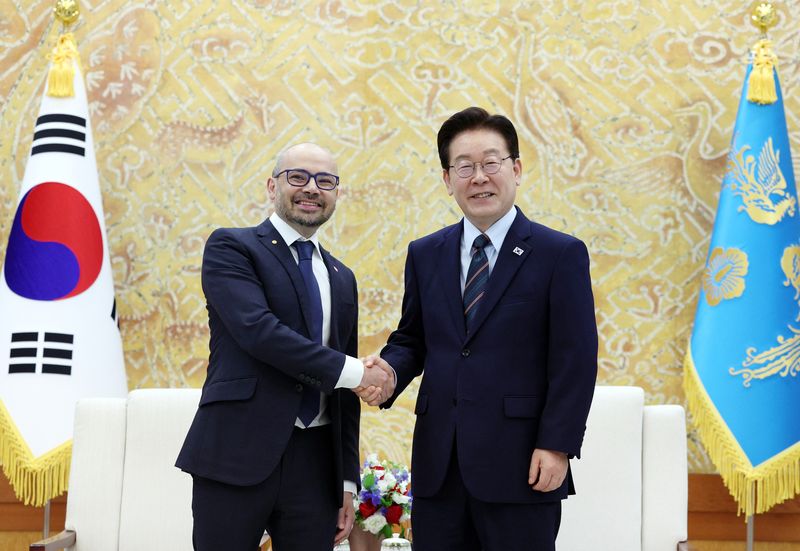
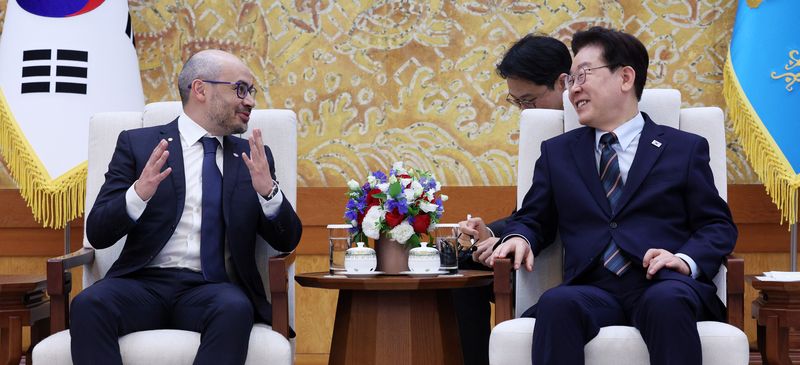
[The Financial News] President Lee Jae-myung met on the 27th with Demis Hassabis, CEO of Google DeepMind and widely known as the father of AlphaGo, to discuss the future of artificial intelligence and possible areas of cooperation. Google also plans to open a Google AI Campus in Seoul later this year and expand collaboration with researchers and startups. Kim Yong-beom, chief presidential secretary for policy, said at a briefing in Chunchugwan Press Center that Hassabis had agreed to consider sending Google researchers to Korea. "We requested that at least 10 people be dispatched, and he agreed on the spot," Kim said. Hassabis, who met with President Lee that day, is expected to continue a series of meetings with major Korean companies including Samsung Electronics, SK hynix and Hyundai Motor Company. Those firms are among the companies already in close discussions with Google on AI cooperation.
At the meeting, President Lee greeted Hassabis at Cheong Wa Dae and said, "Do you know that you are very famous in Korea?" He added, "I also use Google Gemini quite often," expressing his familiarity with the service. Hassabis replied that "today's AI began to take shape in Seoul, where the AlphaGo match took place 10 years ago," and said that "Korea is a very special country for both me and Google DeepMind."
The two sides held in-depth discussions on the rapid recent progress in AI technology, its future direction, responsible use of AI, and ways to strengthen global cooperation. Hassabis, the founder of Google DeepMind, oversaw the 2016 match between Lee Sedol and the Go AI AlphaGo. He later won the 2024 Nobel Prize in Chemistry for developing AlphaFold, an AI model that predicts protein structures.
Before the meeting, President Lee was presented with a Go board signed by Hassabis and Lee Sedol to mark the 2016 AlphaGo match. When Lee joked that "Google Gemini sometimes gives strange answers," Hassabis responded that AI brings enormous opportunities but also carries risks, including malicious use and the danger of AI making autonomous decisions. He said there is a need to build minimum guardrails that can be embedded in AI design, security solutions and shared by the international community. Lee also said international rules or standards are needed to ensure the safe use of AI, but that such frameworks appear to be lacking. Hassabis agreed that the need to establish safeguards is urgent.
When Lee asked when artificial general intelligence (AGI) might be reached, Hassabis said that AGI, which would be capable of using all human cognitive abilities, could emerge within the next five years, or as early as 2030. Kim said Hassabis also predicted that its impact could bring social change greater than the Industrial Revolution, but at a much faster pace. He also said his ultimate goal is to use AI as a tool for scientific discovery.
Kim said President Lee stressed the importance of preparing for unemployment and job displacement caused by AI. Hassabis said it is difficult to predict the impact on jobs, but argued that a new economic model is needed to rethink the definition of work and the redistribution of wealth.
Lee also noted that he had been talking about basic income for more than 20 years and asked whether AI basic income is now needed in the AI era. Hassabis agreed on the need for basic income and said it is also important to consider a system in which the state provides basic services such as housing, education, transportation and health care while incorporating market principles. He also suggested that policymakers should consider support measures for workers who train robots, given the productivity gains from robots that replace jobs, Kim said.
Google and Google DeepMind have agreed to expand concrete AI cooperation with Korea's research and academic communities. They plan to work closely with the government on the K-Moonshot Project. To support this effort, the Ministry of Science and ICT and Google DeepMind will sign an MOU on the same day.
At the end of the meeting, Lee said he hoped that, just as the AlphaGo match 10 years ago opened the dawn of the AI era together with Korea, the two sides could help open a bright future for AI for everyone over the next 10 or 20 years, Kim said.
Kim said, "This meeting is part of the president's ongoing global outreach. He met with Sam Altman, CEO of OpenAI, and Jensen Huang, CEO of Nvidia, in October last year, and discussed cooperation with Masayoshi Son, chairman of SoftBank Group, in November. We will continue to prepare thoroughly so that future meetings with global leaders do not end as simple courtesy calls, but lead to tangible results that can meaningfully benefit Korea's industries and young researchers."
[email protected] Choi Jong-geun Reporter