'Prostitution Comics' in Hands, 'BJ Room Salon' Next to School... 'Poisonous Mushrooms' Infiltrating Teenagers
- Input
- 2026-04-28 07:00:00
- Updated
- 2026-04-28 07:00:00
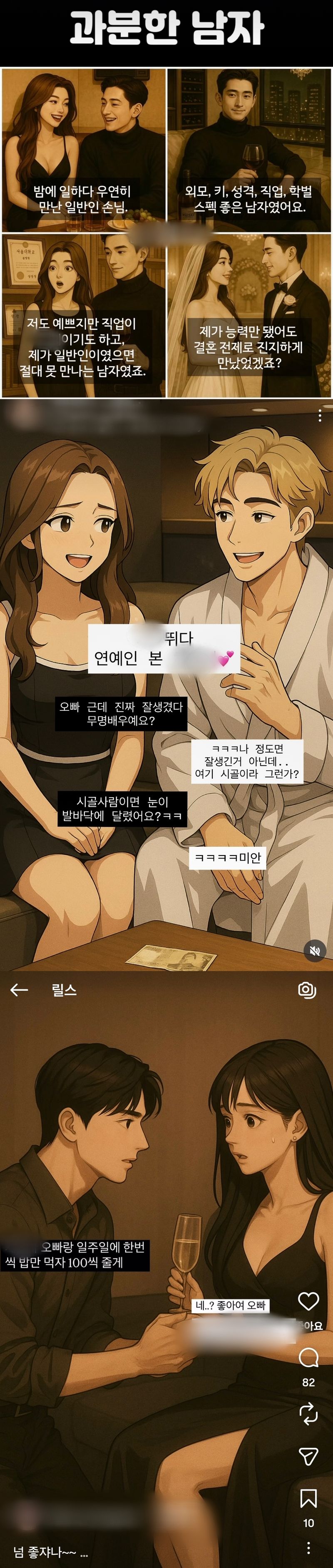
There are growing concerns that such content could lower adolescents' vigilance against prostitution and instill distorted perceptions. It is pointed out that while harmful facilities such as adult broadcasting studios are being established near schools, regulation is difficult under current laws, leaving adolescents exposed to harmful environments across both online and offline platforms. According to a comprehensive report by Financial News on the 28th, cartoon content glorifying experiences of prostitution and daily life in entertainment establishments, utilizing generative artificial intelligence (AI), is rapidly spreading on social media platforms such as Instagram.5 million won. I guess I have to go out (to work at night) on my days off" or "Let's just have dinner once a week, I'll give you 1 million won. " Concerns are being raised that the majority of content reflects a view that trivializes sex as a commodity, potentially leading people to accept prostitution as a realistic option or a legitimate profession.In fact, there have been a series of instances where teenagers who encounter such posts express an intention to participate in prostitution beyond mere curiosity, making comments such as, "I have a fling too," "How much do you earn working at night?" and "Even people born in '08 are working these days. " However, it is difficult to sanction such content under the current "Act on the Punishment of Acts of Prostitution and Related Activities. " This is because if the content takes the form of 'personal experiences' rather than direct brokering or advertising, it does not meet the requirements for punishment, even if there is a high likelihood of inducing prostitution.
Seo Hye-jin, Managing Partner at The Lighthouse Law Firm, explained, "While advertisements seeking buyers directly could be classified as brokering, content uploaded in the form of personal experiences like this is difficult to view as brokering under current law. Furthermore, it is difficult to find evidence to support organized movements or brokering intentions," adding, "In many cases, it falls outside the scope of legal punishment. " Yang Jin-young, Managing Partner at Minhu Law Firm, also pointed out, "Current laws such as the Special Act on Sexual Violence are structured so that punishment is possible only when specific behavioral requirements are met.
However, content glorifying prostitution often remains at the level of 'obscene or inappropriate information,' failing to meet those requirements. " Article 74 of the Information and Communications Network Act stipulates that posting obscene content is punishable by imprisonment of up to one year or a fine of up to 10 million won; however, as content creation has become easier with generative AI, related posts have surged, making the reality Analysis suggests that there are limits to sanctions.
The offline environment is not much different. Recently, a building located about 100 meters from an elementary school in Gangnam, Seoul, sparked controversy when an adult broadcasting studio, known as a "cyber room salon," moved in.
Although it is a space where various female internet broadcasters (BJs) produce broadcasts featuring provocative dances or stimulating behavior, it is classified as a "studio rental business" in business registration and is therefore not included in the restricted business categories under the Education Environment Act. The current Education Environment Act designates areas within a straight-line distance of 200 meters from school boundaries as protection zones to restrict the operation of harmful businesses that hinder students' learning and educational environments; however, new types of businesses like this one are sometimes excluded from regulation.
As the police and local governments also determined that it was difficult to regard the facility as an establishment harmful to youth, no actual sanctions were imposed. Park Nam-ki, a professor in the Department of Education at Gwangju National University of Education, stated, "With new business types continuously emerging, gaps are inevitable in areas not explicitly listed in the law.
" He added, "It is necessary to establish the authority and structure for the Office of Education and relevant agencies to consult and decide on sanctions, so that harmfulness can be judged based on the actual activities and their impact on youth, rather than the type of business. " He further emphasized, "We must issue a public notice stating that measures such as business suspension can be taken if harmfulness is recognized, and establish procedures requiring facilities opening near schools to undergo prior review by the Office of Education and other relevant agencies.
"
[email protected] Kim Ye-ji Reporter