China, France and Others Are Already in Diplomatic Offensive... K-Rail Bets on Technology Transfer and Partnerships [Vietnam High-Speed Rail Bid]
- Input
- 2026-04-26 18:48:14
- Updated
- 2026-04-26 18:48:14
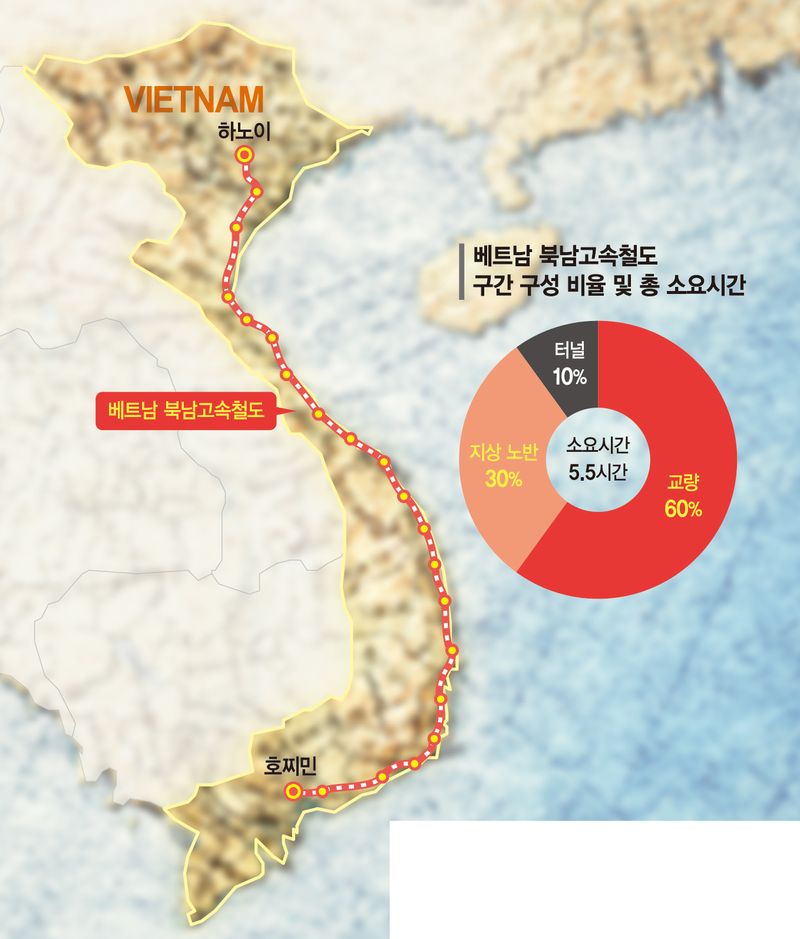
Infrastructure industry sources in Hanoi generally expect the future bidding outlook for the North–South express railway, Vietnam's largest infrastructure project in history, along those lines.
A fierce diplomatic contest has begun ahead of the year-end selection of the operator for the mega project, which will build a 350-km/h railway along the 1,541-km route connecting Hanoi and Ho Chi Minh City. South Korea is widely seen as the frontrunner, but China, Japan and France have all launched their own rail diplomacy with their heads of state personally stepping in. Spain has now joined the race as well, turning the bid into an increasingly complex five-way contest.
■ Summit-level diplomacy among South Korea, China, Japan, France and Spain
On the 15th, Chinese President Xi Jinping repeatedly emphasized railway cooperation during his meeting with To Lam, the General Secretary of the Communist Party of Vietnam and state president, making clear Beijing's intent to win the North–South express railway contract. During his visit to China, Lam also took a ride on the Fuxing Hao high-speed train to assess its technology firsthand.
China is leveraging its geographic proximity and financial strength to propose loans and an early start to construction. It is also already moving ahead with the Lao Cai–Hanoi–Hai Phong railway, which it has secured.
Japan, France and Spain are also intensifying their push through summit-level diplomacy. Japan is promoting a financing package that combines the safety and operational expertise of the Shinkansen with Official Development Assistance (ODA). It is expected to reaffirm its participation when Prime Minister Sanae Takaichi visits Vietnam next month.
France is expanding its presence with President Emmanuel Macron personally promising technology transfer. Spanish Prime Minister Pedro Sánchez has also entered the race, highlighting the high-speed rail system's AVE technology for difficult terrain.
■ Technology transfer and local cooperation as the winning formula
South Korea is putting technology transfer and local partnerships at the center of its Team Korea approach. President Lee Jae-myung used his state visit from the 21st to the 24th to underscore the competitiveness of Korean high-speed rail and support corporate participation. During the visit, Hyundai Rotem won a contract to supply rolling stock for the Ho Chi Minh City Metro, which is seen as laying the groundwork for a bid on the North–South express railway.
As the Vietnamese government has decided to reduce reliance on foreign loans and expand participation by domestic companies, Korean firms that are actively cooperating with local partners are reportedly receiving a favorable response from Hanoi.
Hyundai Rotem, a core member of Team Korea, is presenting its next-generation EMU-370 high-speed train, capable of speeds of up to 370 km/h, while also emphasizing long-term partnerships that include technology transfer, workforce training and maintenance, repair and overhaul (MRO). Drawing on its experience winning a high-speed rail contract in Uzbekistan, the company is stressing that it can export an entire rail system, not just rolling stock. However, despite its willingness to transfer technology and offer a package-based export model, Korean design firms are seen as weaker than rivals when it comes to experience in large-scale infrastructure construction.
■ Securing the signaling system is the key battleground
Locally, the formation of a consortium with Vietnamese companies is being viewed as a crucial factor that could determine the outcome of the bid. In April 2026, Vietnam's National Assembly will give final approval to the budget for the North–South express railway and has already set the principle of "minimizing dependence on foreign loans, prioritizing state budget funding, and maximizing participation by Vietnamese companies."
Technology transfer is also expected to be an important criterion in the selection of the winning bidder. A Hanoi-based industry source said, "Vietnamese authorities have painful experience from past infrastructure projects, when delays, cost overruns and difficulties in sourcing parts left them at the mercy of certain countries." The source added that the government wants Vietnamese companies to build the capability to handle maintenance and repairs on their own, without relying on overseas support every time a breakdown occurs or parts need replacing. Mainline construction, rolling stock, signaling systems and transit-oriented development (TOD) around stations are all expected to be key battlegrounds. Among them, the signaling system is being described as the project's final निर्णative arena.
[email protected] Reporter