OECD Says South Korea's Potential Growth Rate Will Fall to 1.57% Next Year... Structural Reform Urgently Needed
- Input
- 2026-04-26 18:45:17
- Updated
- 2026-04-26 18:45:17
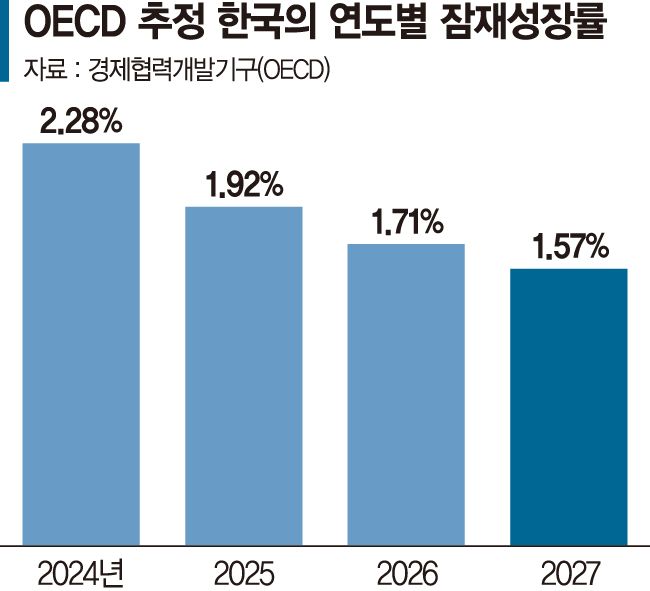
According to the latest data from the Organisation for Economic Co-operation and Development (OECD) on the 26th, South Korea's potential growth rate is estimated to fall by 0.21 percentage points from 1.92% last year to 1.71% this year. It is then expected to drop by another 0.14 percentage points to 1.57% next year. The OECD also forecast that the country's potential growth rate in the fourth quarter of next year, compared with the same period a year earlier, will come in at just 1.52%, suggesting the gradual decline will continue.
Potential growth rate refers to the growth rate of potential GDP. Potential GDP is the maximum level of output a country can achieve by fully utilizing all production factors, including labor, capital and resources, without triggering inflation.
Based on the OECD's latest estimates, South Korea's potential growth rate has continued to decline since 2012, when it stood at 3.63%. After falling below 2% last year, it has yet to find a rebound.
The BOK also does not dispute that South Korea's potential growth rate has remained on a downward trend, although its own estimates differ.
In a report released in December 2024, the BOK projected that potential growth would keep falling, to 2.1% in 2021-2023, 2.0% in 2024-2026 and 1.8% in 2025-2029.
Some observers are also warning about the side effects of an unusual structure in which the semiconductor manufacturing sector accounts for more than half of growth. They argue that an economy dependent on a single industry could ultimately weaken its fiscal base.
There are also concerns that excessive concentration in one industry could leave other sectors vulnerable, leading to Dutch disease.
Structural reform is being cited as the way out of this bleak outlook. The goal is to fundamentally improve the economy during this critical window so that South Korea can reverse the decline in potential growth caused by low birth rates, aging and slowing productivity.
In his inauguration speech, Hyun-Song Shin, Governor of the Bank of Korea, said, "We must also play an active role in addressing the structural reform tasks facing our economy." At a meeting with Koo Yun-cheol, Deputy Prime Minister and Minister of Economy and Finance, on the 23rd, he stressed communication and cooperation among authorities, saying, "We need to build up growth potential through structural reform."
[email protected] Seo Young-joon Reporter