Individuals Bet on Further Gains, While Foreign Investors and Institutions Bet on a Decline... Diverging Sentiment on the KOSPI Composite Index
- Input
- 2026-04-26 18:40:50
- Updated
- 2026-04-26 18:40:50
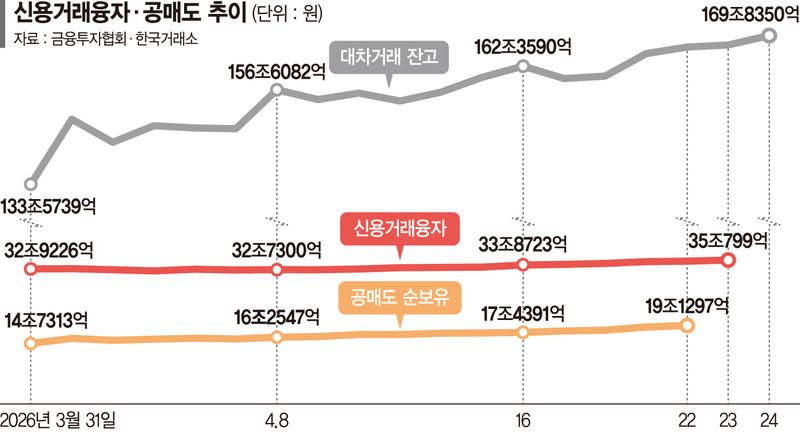
According to the Korea Financial Investment Association (KOFIA) on the 26th, margin loan balances stood at 35.0799 trillion won as of the 23rd. The figure has risen by more than 2 trillion won so far this month, surpassing 35 trillion won for the first time.
Margin loans refer to the amount investors have borrowed from securities firms to buy stocks and have not yet repaid. They are a key gauge of retail investors' margin debt. The larger the balance, the stronger the expectation for index gains. Margin loan balances first topped 30 trillion won at the end of January and have continued to rise steadily since then. Growth appeared to slow last month as volatility increased due to the Middle East war, but the pace has accelerated again this month.
By contrast, foreign investors and institutions appear to be leaning toward a correction. Both short-selling positions and securities lending balances, which provide the ammunition for short selling, have hit record highs.
As of the 22nd, the net short-selling balance on the KOSPI Market stood at 19.1297 trillion won, up by more than 4 trillion won this month alone. Securities lending balances reached 169.835 trillion won as of the 24th, coming close to 170 trillion won.
Securities lending is a transaction in which foreign investors or institutions lend stocks to other investors for a fee, and it is considered a leading indicator for short selling. Together with short selling, the increase in securities lending balances suggests that more money is being placed on a market decline.
Securities lending balances have been rising sharply alongside the stock market boom. In January last year, they were only in the 40 trillion to 50 trillion won range, but they first entered the 100 trillion won range in September. The pace accelerated further this month. At the end of last month, securities lending balances stood at 133.5739 trillion won, and they have increased by more than 36 trillion won so far this month.
In the securities industry, the prevailing view is that the KOSPI Composite Index will continue its earnings-driven rally, as the market has become more resilient to geopolitical risks amid the prolonged Middle East war.
Kim Jongmin, a researcher at Samsung Securities Co., Ltd., said, "As the market impact of the Middle East war gradually diminishes, the current uptrend is unlikely to be easily reversed and will likely move to a higher level." He added, "A record-breaking rally that rises while absorbing supply creates a powerful inertia of its own."
Some analysts also say the KOSPI Composite Index could surpass the 8,000 level this year if favorable conditions emerge, such as supportive interest rate policy and gains in the semiconductor sector. Lee Jae-man, a researcher at Hana Securities Co., Ltd., said, "If the Federal Reserve System (Fed) does not keep its benchmark rate unchanged and semiconductor price-earnings ratio (PER) does not rise, the upper end of the KOSPI Composite Index is expected at 7,540." He added, "If the Fed cuts rates once or twice and semiconductor PER reaches 8.0 times, the upper end could be as high as 8,470."
A short-term correction is also being raised as a possibility if profit-taking increases. Moon Hong-cheol, a researcher at DB Securities Co., Ltd., said, "It is common for investors who bought near the KOSPI Composite Index peak to sell once their losses have been recovered." He added, "However, if there is confidence that the KOSPI Composite Index is returning to an uptrend, selling pressure will not intensify."
[email protected] Reporter Seo Min-ji Reporter