Korean Market ETFs Double in Size, Overtake U.S.-Tracking Funds
- Input
- 2026-04-26 18:40:48
- Updated
- 2026-04-26 18:40:48
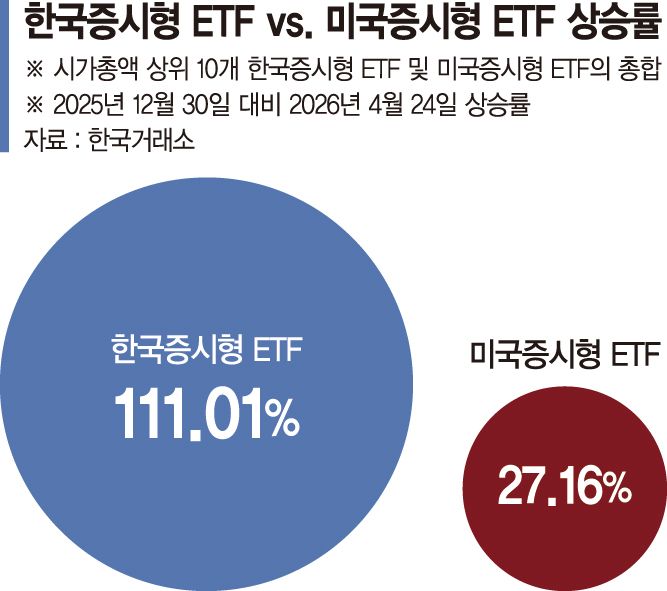
According to the Korea Exchange (KRX) on the 26th, the combined market capitalization of the top 10 ETFs tracking the KOSPI and KOSDAQ Composite Indexes stood at 79.32 trillion won as of the 24th, surpassing the 61.41 trillion won in net assets held by the top 10 ETFs tracking the Nasdaq and Standard & Poor's (S&P) 500 indexes.
Until last year, the market capitalization of Korea stock market ETFs had not exceeded that of U.S. stock market ETFs. At the end of last year, on Dec. 30, 2025, the top 10 domestic stock ETFs had a combined market capitalization of just 37.59 trillion won. At the time, the top 10 U.S. stock ETFs were worth 48.29 trillion won, about 10 trillion won more than their Korean counterparts.
This year, however, the combined market capitalization of the top 10 domestic equity ETFs more than doubled, jumping from 37.59 trillion won to 79.32 trillion won, a gain of 111.01%. That far outpaced the 27.16% increase in the top 10 U.S. stock ETFs over the same period.
The race for the No. 1 spot in the ETF market has also shifted. Until the end of last year, the largest ETF in Korea by market capitalization was TIGER U.S. S&P 500, which tracks the S&P 500 Index, with 12.7103 trillion won. But this year, it lost the top position. Samsung KODEX 200, which tracks the KOSPI 200 Index, took the lead. At the end of last year, KODEX 200 ranked second with 11.7192 trillion won, behind TIGER U.S. S&P 500. On Jan. 27, KODEX 200's market capitalization of 14.3493 trillion won overtook TIGER U.S. S&P 500's 14.1788 trillion won, and the gap has widened since then. As of the 24th, KODEX 200 stood at 21.9128 trillion won, nearly double its year-end level and about 5 trillion won higher than TIGER U.S. S&P 500's 16.4252 trillion won.
Market watchers say KOSPI's strong performance has also influenced the domestic ETF market. According to Investing.com, KOSPI was the best-performing major global index this year, with a return of 53.66%. Over the same period, the NASDAQ Composite Index rose 6.86%, the S&P 500 gained 4.67%, and the DJIA advanced 2.43%. The KOSDAQ also climbed 30.08%, outperforming U.S. stock markets. In the ETF market, the number of U.S. stock ETFs fell from 202 at the end of last year to 181 recently, while domestic stock ETFs increased from 389 to 421.
The rise of domestic stock ETFs was also evident among individual funds. Among the top 20 ETFs by market capitalization in Korea's ETF market, five were domestic stock ETFs at the end of last year: Samsung KODEX 200 ETF, Mirae Asset TIGER 200 ETF, Samsung KODEX 200 Total Return ETF, KODEX Leverage ETF, and Mirae Asset TIGER MSCI Korea Total Return ETF. Since then, four more have been added — Mirae Asset TIGER Fn Semiconductor TOP 10 ETF, Samsung KODEX KOSDAQ 150 ETF, KODEX Semiconductor ETF, and Samsung KODEX 200 Target Weekly Covered Call ETF — bringing the total to nine.
In particular, Mirae Asset TIGER Fn Semiconductor TOP 10 ETF, which invests in 10 domestic semiconductor companies, ranked 21st overall at the end of last year with a market capitalization of 2.8274 trillion won. By the 24th, it had surged more than threefold to 9.89 trillion won, lifting it to third place in the rankings. TIGER US Philadelphia Semiconductor NASDAQ, which had a larger market capitalization than TIGER Fn Semiconductor TOP 10 ETF through the end of last year at 3.2489 trillion won, rose by only about 1 trillion won this year to 4.6204 trillion won. It was overtaken by TIGER Fn Semiconductor TOP 10 ETF, which reached 9.89 trillion won, as well as KODEX Semiconductor ETF, which stood at 4.8256 trillion won.
[email protected] Han Young-jun Reporter