"I'd rather go to Samsung Electronics than medical school" ... contract department cutoff hits all-time high
- Input
- 2026-04-26 18:23:54
- Updated
- 2026-04-26 18:23:54
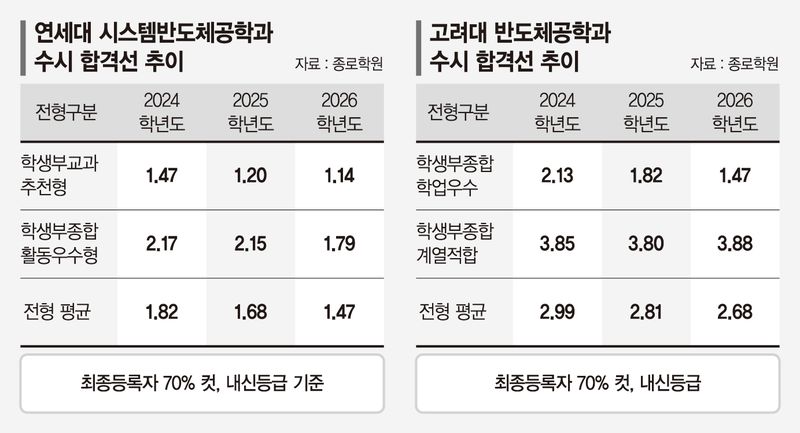
Jongro Academy announced on the 26th the early-admission results for the corporate contract semiconductor departments at Yonsei University and Korea University, based on the 70% cutoff score disclosed through admissions briefings and other events.
Lim Seong Ho, head of Jongro Academy, said, "Among top students who are not aiming for medical school, semiconductor contract departments have become a practical alternative." He added, "Interest in these programs could grow even further in the class of 2027."
According to the analysis released by Jongro Academy, the average admission score for Yonsei University's Department of Systems Semiconductor Engineering, which is partnered with Samsung Electronics, was 1.47 in the 2026 academic year for its school record and comprehensive admissions tracks. Korea University's Department of Semiconductor Engineering, which has an agreement with SK hynix, posted an average of 2.68 in its academic excellence and major-fit tracks, setting the highest cutoff since each department was established.
The Department of Systems Semiconductor Engineering at Yonsei University, which is partnered with Samsung Electronics, saw a clear rise in cutoffs across major admissions tracks. Its recommendation track, which relies heavily on school records, improved for three straight years, from 1.47 in the 2024 academic year to 1.20 in 2025 and 1.14 in 2026. The comprehensive admissions track for outstanding activity also rose to 1.79 in 2026, up 0.36 points from 2.15 the previous year and the highest level since the department opened.
Korea University's Department of Semiconductor Engineering, which is contracted with SK hynix, recorded a 1.47 cutoff in 2026 for its comprehensive admissions track for academic excellence. Compared with 2.40 in the department's first year in 2021, the score improved by nearly one full grade.
In the comprehensive admissions major-fit track, the 2026 cutoff slipped slightly to 3.88 from 3.80 the previous year. Analysts attributed the change to a higher share of successful applicants from specialized high schools such as science high schools. Still, the average score across the two tracks reached 2.68, the highest in six years.
The upward trend was also evident in regular admissions. For Korea University's Department of Semiconductor Engineering, the 70% cutoff for the general track, based on Korean, math and inquiry percentile scores, rose steadily from 94.17 in the 2024 academic year to 96.67 in 2026. Yonsei University did not separately disclose its regular-admission cutoff for 2026.
In particular, Yonsei University's 1.14 cutoff in the recommendation track and Korea University's 1.47 cutoff in the academic excellence track are considered comparable to medical school admission levels. However, because the admissions methods differ greatly, a direct comparison between the two universities is not appropriate.
Yonsei University's recommendation track limits each school to up to 10 nominees, while Korea University's academic excellence track has no nomination cap and selects students based entirely on document screening. The two departments also tend to admit many students from science high schools and autonomous private high schools, which should be taken into account.
Lim Seong Ho said, "In the past, interest among the very top students was split between medical school and engineering at Seoul National University. Now, some of that attention is shifting to the semiconductor contract departments at Yonsei and Korea universities." He added, "The trend is likely to continue in the class of 2027, but admission cutoffs and popularity could change depending on corporate performance."
For the class of 2027, Samsung Electronics plans to recruit 350 students from seven universities, including Yonsei University and Sungkyunkwan University, while SK hynix plans to recruit 110 students from three universities, including Korea University and Sogang University. In total, the two companies plan to recruit 460 students. One lingering variable, however, is that if students are admitted to both medical school and a contract department, they are still more likely to choose medical school in the end.
monarch@fnnews.com Kim Man-gi Reporter