"KOSPI 8,470?" Securities firms say a weaker dollar will be the turning point
- Input
- 2026-04-27 06:00:00
- Updated
- 2026-04-27 06:00:00
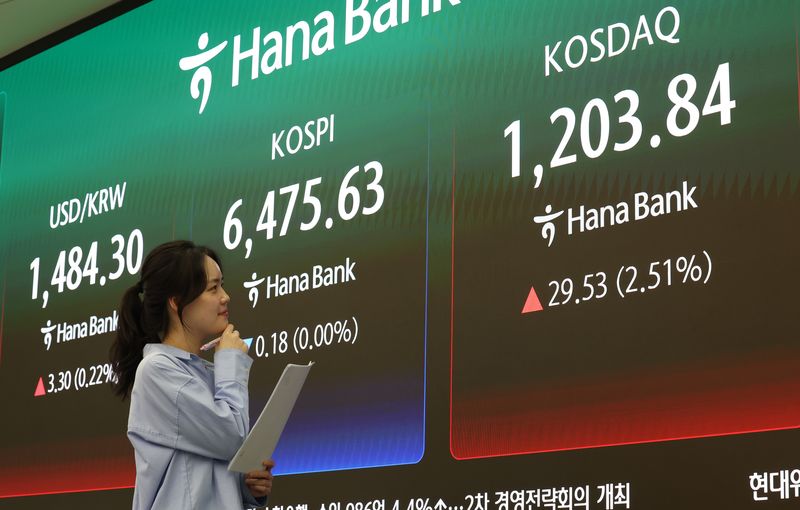
[The Financial News] The KOSPI Composite Index could rise as high as 8,470 in the second half of the year if the Federal Reserve System (Fed) cuts interest rates, the dollar weakens, and semiconductor valuations are reassessed, according to a new outlook.
On the 27th, Hana Securities Co., Ltd. said its projected upper range for the KOSPI Composite Index in the second half of the year stands at 7,540 to 8,470 points, depending on the scenario. If the Fed keeps its benchmark rate unchanged and semiconductor price-to-earnings ratios do not rise, the index ceiling is estimated at 7,540 points. By contrast, if the Fed cuts rates once or twice and the KOSPI semiconductor PER rises to 8.0 times, the average level of Micron Technology, Inc., the upper end would be calculated at 8,470 points.
Lee Jae-man, a researcher at Hana Securities Co., Ltd., said, "If the likelihood of Fed rate cuts rises, a weaker-dollar environment is likely to form." He added, "For the KOSPI, the key factors determining the index ceiling will be whether foreign buying improves in semiconductors and whether PERs rise."
The current rise in the KOSPI Composite Index is being driven by earnings growth. In other words, improved results, rather than valuation expansion, have powered the market's gains. Semiconductors are the key variable. The 12-month forward earnings of KOSPI semiconductor stocks are at record highs, but their 12-month forward PER stands at just 5.2 times. By comparison, Nvidia Corporation and TSMC trade at average PERs of 22.7 times and 21.6 times, respectively, while Micron Technology, Inc. is at around 8.0 times.
Lee explained, "KOSPI semiconductors are still being valued as cyclical industries rather than as extremely undervalued stocks, which is why they are receiving low PERs." He added, "Given earnings and global supply-demand conditions, a Micron-level valuation is entirely possible."
Foreign investor flows are also an important factor. Foreign ownership in Samsung Electronics Co., Ltd. has fallen to 49.14%, the lowest level since 2020, while SK hynix Inc. has dropped to 53.01%, near its lowest point since 2024. Analysts say that if dollar weakness becomes more pronounced, there is significant room for foreign buying to resume.
Lee said, "In the United States, interest rates move the market, while in Korea, the dollar moves the market." He added, "As the dollar weakens, foreign flows into Samsung Electronics and SK hynix can improve at the same time as valuations rise."
Meanwhile, the peak operating profit margins for Samsung Electronics and SK hynix are both expected in the second quarter of 2027. Analysts also noted that, in the past, stock prices tended to peak about two months before operating profit margins did, suggesting that the leadership cycle could continue.
Lee said, "The peak in semiconductor operating margins is still ahead, and the sectors that led the market when the KOSPI broke to a record high also remained leading sectors until the next peak." He added, "If weaker-dollar conditions and improved foreign flows are confirmed, further gains led by semiconductors are possible."
[email protected] Choi Du-seon Reporter