Jensen Huang's 'Worst-Case' Scenario Becomes Reality, Raising Variables for K-Semiconductor and AI Infrastructure
- Input
- 2026-04-25 16:40:47
- Updated
- 2026-04-25 16:40:47
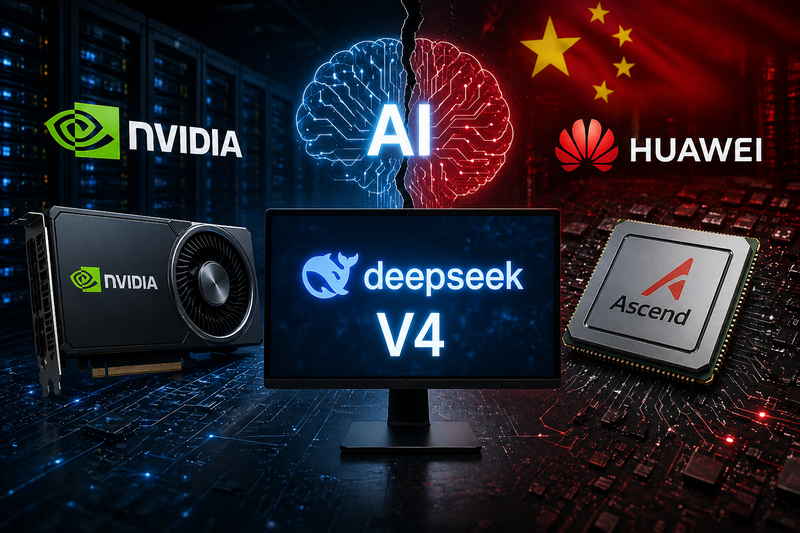
[Financial News] Chinese artificial intelligence (AI) startup DeepSeek has unveiled its next-generation large language model, "V4," on Huawei's semiconductor platform for the first time. As signs emerge of cracks in the global AI computing structure long dominated by Nvidia Corporation, the combination of Chinese-made models and chips is being seen as moving into real-world deployment.
According to Chinese IT outlet MyDrivers and others on the 25th, DeepSeek V4 was first unveiled while running on Huawei's Ascend platform. Huawei said it showcased the model in its CANN environment, its AI computing framework. The move is being viewed as an unusual case in which a high-performance AI model has advanced to actual service deployment on domestic semiconductors.
The development is also being interpreted as a case that brings Nvidia CEO Jensen Huang's concerns to life. In a recent podcast interview, Huang said, "If DeepSeek is optimized for Huawei chips, that would be a very terrible outcome," adding, "If AI spreads in ways other than the American technology stack, China could secure technological leadership."
He also stressed that China's competitiveness is not limited to semiconductor performance alone. Roughly half of the world's AI researchers are based in China, and even in environments with limited computing resources, they are developing efficient algorithms and rapidly narrowing the gap. The "Mixture of Experts (MoE)" architecture popularized by DeepSeek is also cited as a representative example of this trend.
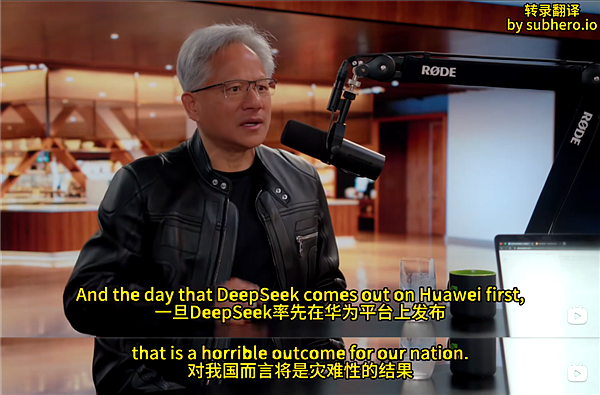
Huang also said, "AI is fundamentally a parallel computing problem," and added, "Sufficient performance can be achieved by connecting and using more chips." He meant that in environments with abundant energy supply, the performance gap between chips can be offset to some extent.
This view also aligns with remarks made by Huawei founder Ren Zhengfei. In a recent interview, Ren said, "Ascend chips are one generation behind U.S. products, but they can reach top-tier performance through clustering and stacking technologies."
Market watchers say the case may be an early signal of a shift in the AI industry structure. In fact, major Chinese AI chip companies such as Hanguzhi, Hygon Information Technology, and Moore Threads have also announced support for DeepSeek V4, accelerating the expansion of a multi-platform ecosystem.
Ultimately, the key issue in this shift is that competition is moving away from chip performance and toward ecosystems. Unlike Nvidia Corporation, which has dominated the market through its CUDA-based software ecosystem, China is building a new alternative by combining algorithm optimization, parallelization strategies, domestic talent, and energy infrastructure.
Analysts say these changes could have some impact on South Korea's industry, making it necessary to watch future developments closely. Since the country's semiconductor and AI infrastructure has largely been built around Nvidia graphics processing units (GPUs), a diversification of global standards could prompt some strategic adjustments. In particular, attention is turning to whether major chipmakers such as Samsung Electronics and SK hynix will change their response strategies for memory and AI infrastructure. However, some also say the effects on data center investment directions, software optimization strategies, and power demand structures may remain limited for now.
[email protected] Gu Ja-yun Reporter