From May, Attachment of '.hwp' Files to Public Documents Will Be Restricted... To Improve AI Usability
- Input
- 2026-04-24 10:27:21
- Updated
- 2026-04-24 10:27:21
On the 24th, the National AI Strategy Committee said it would restrict attachment of '.hwp' files, which have low AI recognition efficiency, in the On-nara System, Onmail, and the Integrated Government Employee Email Service, the main channels for public document distribution, together with the Ministry of the Interior and Safety (MOIS) and the Ministry of Culture, Sports and Tourism (MCST), as part of efforts to convert the public-sector document distribution system to open formats.
Although the usefulness of Korean-language documents is improving, with OpenAI recently announcing support for reading hwp files in ChatGPT, '.hwp' files have a closed structure that makes it difficult for AI to analyze and learn internal information. The government therefore plans to standardize public documents on the open '.hwpx' format.
Starting May 18, MOIS will first restrict attachment of '.hwp' files in the 'On-nara System,' the official document distribution system, including local governments. The 'Onmail' communication tool for civil servants will also move toward an open-format transition from October.
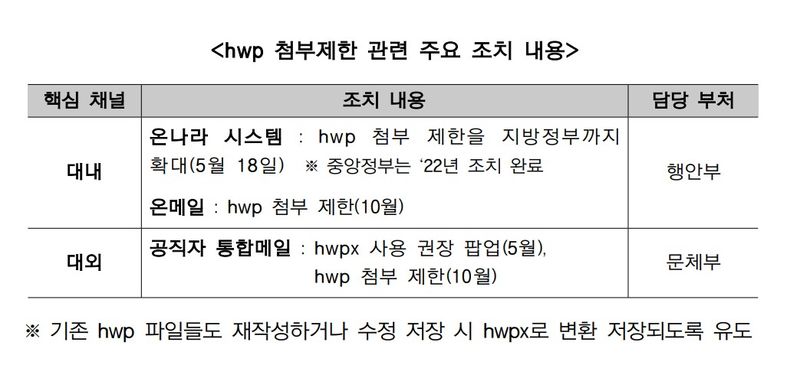
External communication channels will also be changed in stages. MCST plans to begin guidance encouraging the use of '.hwpx' in the 'Integrated Government Employee Email Service' from May, and after a grace period, to restrict attachment of '.hwp' files from October.
Existing '.hwp' documents will also be converted gradually. MOIS plans to encourage documents to be saved automatically in '.hwpx' format when they are rewritten or edited.
The measure follows a proposal from the data subcommittee of the National Artificial Intelligence Strategy Committee, chaired by Eunok Paek, professor in the Department of Computer Science and Software Engineering at Hanyang University College of Engineering, that attachment of '.hwp' files rather than '.hwpx' files should be fundamentally restricted in public-sector distribution channels. Government ministries have now begun full-scale implementation.
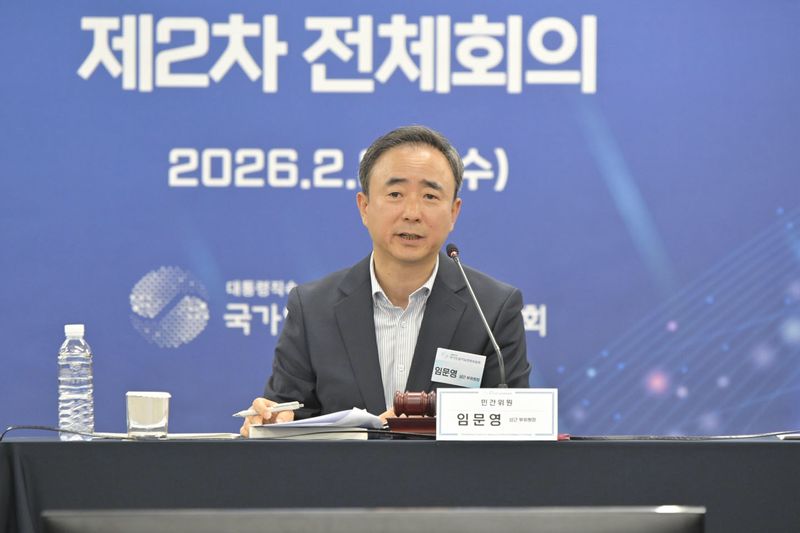
Im Moon-young, vice chair of the National AI Committee, said, "Starting with this measure, we will work with relevant ministries to firmly implement 'small but significant, fast-moving changes' for public-sector data innovation in the AI era."
[email protected] Lee Gu-soon Reporter