[Editorial] Semiconductor-Led Surprise Growth Shows the Need to Build Strength to Overcome Polarization
- Input
- 2026-04-23 18:33:59
- Updated
- 2026-04-23 18:33:59
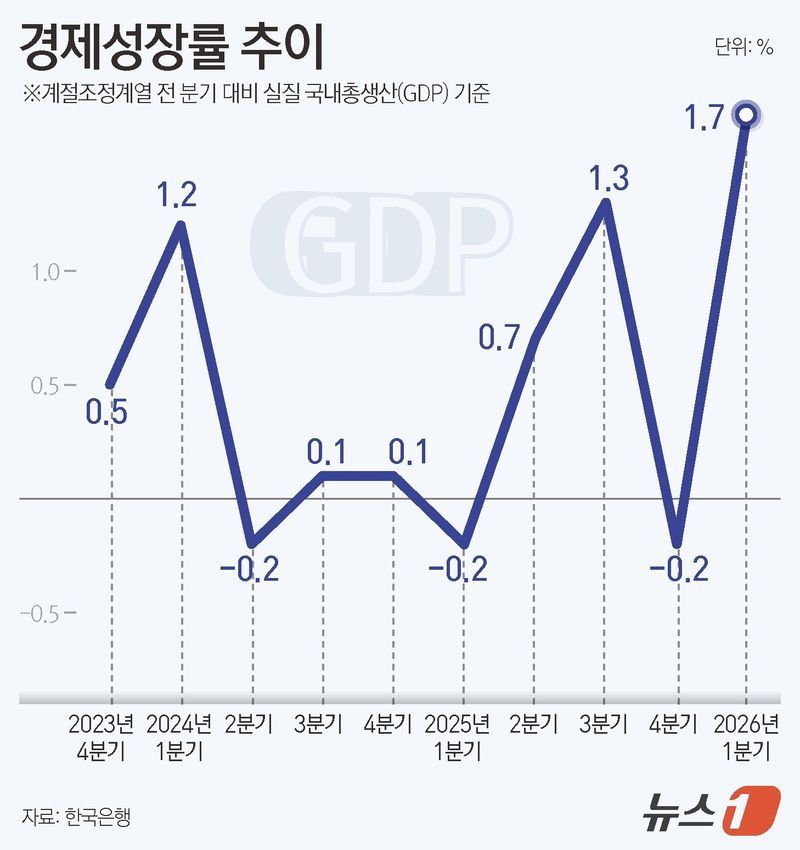
Given the extreme uncertainty in domestic and external conditions, including the fallout from the Middle East war, the figure can at least be seen as a welcome sign. Another notable point is that private consumption, which had been frozen solid, improved, led by goods such as clothing. The main driver of growth was once again semiconductor exports. Exports centered on semiconductors and information technology (IT) surged, and investment in semiconductor facilities also rose steadily. Construction investment increased by nearly 3%. Real Gross Domestic Income also jumped 7.5% from the fourth quarter, the highest level since the first quarter of 1988.
It is encouraging to see improved indicators. The problem is that South Korea's industrial structure is becoming increasingly locked into an imbalance that relies on a handful of sectors. According to the BOK, semiconductor manufacturing accounted for 55% of the growth contribution. In other words, without semiconductors, first-quarter growth could have been cut by more than half. South Korea's semiconductor industry has become the biggest beneficiary of the super boom driven by surging demand from Artificial Intelligence (AI).
SK hynix Inc., which released its earnings on the same day, posted an operating profit of 37.6 trillion won in the first quarter, setting a new all-time high. That was more than 400% higher than a year earlier. Its operating margin reached an astonishing 72%. For a manufacturer, that is an extraordinary result. Taiwan Semiconductor Manufacturing Company Limited (TSMC), widely regarded for its overwhelming profitability, posted an operating margin of 58% in the first quarter. SK hynix Inc. beat TSMC's operating margin for a second straight quarter. Samsung Electronics Co., Ltd., which had announced its results earlier, also posted record first-quarter earnings.
South Korea should not be satisfied simply because the country's two semiconductor giants are among the world's best. The urgent task is to prepare for what comes after semiconductors. Once the semiconductor illusion is stripped away, the industrial landscape looks alarmingly fragile. Under China's low-price offensive, South Korea's steel, petrochemical, and refining industries, among other key sectors, have been pushed to the brink. Warnings that manufacturing sovereignty is being shaken are sounding every day. The country must pursue a major turnaround by separating the viable from the unviable through bold restructuring and innovation.
To maintain a technological lead in semiconductors, the government must provide comprehensive support. At the same time, industry, academia, and research institutions need to work harder to develop the next generation of growth engines that can follow semiconductors. South Korea should strengthen the foundation for new growth drivers such as defense, nuclear power, biotech, and robotics, while the public and private sectors move together to open new markets.
The more companies that generate profits, the more taxes and jobs will grow. The government should consider a range of policies that can boost companies' willingness to invest. Excessive demands for performance bonuses, to the point of creating social friction, should be restrained. In the long run, using corporate profits for future investment benefits both companies and workers. At industrial sites, many are already locked in conflict over overly aggressive labor-related legislation. There is more than one law that needs revision, including the Yellow Envelope Law. Follow-up measures must be taken quickly and in line with reality. The real-economy shock from the Middle East will become visible after the second quarter. South Korea has no choice but to devote itself to strengthening its fundamentals and pushing ahead with structural reform.