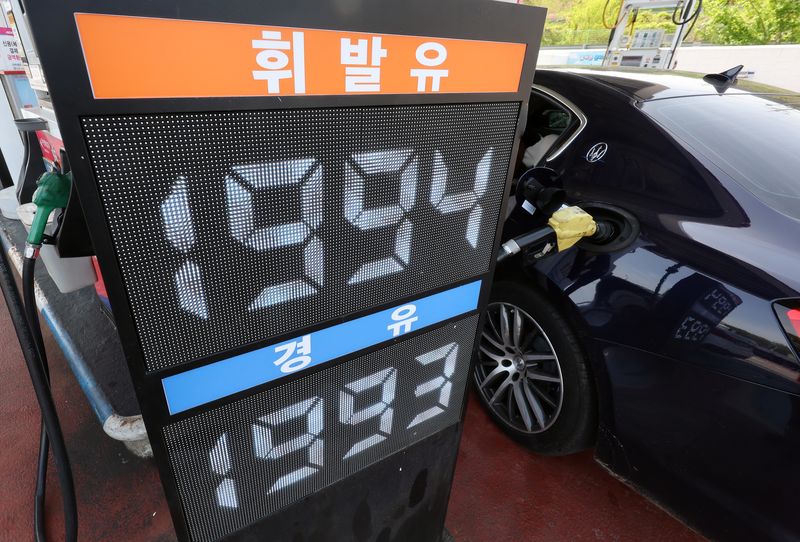
"Gasoline at 1,934 won and diesel at 1,923 won frozen" ... Demand management maintained despite falling oil prices
- Input
- 2026-04-23 19:00:00
- Updated
- 2026-04-23 19:00:00
[The Financial News]
The government has frozen the ceiling price for petroleum once again. Although international oil prices have recently been falling, the decision also took into account continued volatility and the need to manage demand.
On the 23rd, the Ministry of Trade, Industry and Energy (MOTIE) said it will keep the fourth ceiling price for petroleum, effective from the 24th, unchanged at 1,934 won per liter for gasoline, 1,923 won for diesel and 1,530 won for kerosene. The levels are the same as those of the second and third ceiling prices.
Kyungmo Nam, senior presidential secretary for policy at MOTIE, said, "Under the basic purpose of the ceiling price system, which is to stabilize livelihoods, we comprehensively considered fluctuations in international oil prices caused by the war in the Middle East, the need to manage demand, and support for consumers using petroleum for their livelihoods and vulnerable groups."
The ministry explained that the decision to freeze the ceiling price despite falling global oil prices was also influenced by the need to manage demand. Nam said, "If we mechanically apply only the two-week change in international petroleum product prices according to the formula, the fourth round would require a cut of about 100 won for gasoline and about 200 won for diesel compared with the third round. However, we decided to freeze the price after taking into account the fact that the increases in international petroleum product prices were not fully reflected in the previous three ceiling price decisions, as well as the burden on ordinary households, inflation, and petroleum consumption management."
The government also reaffirmed how losses for refiners will be compensated. Under the Petroleum and Alternative Fuel Business Act, the government will cover losses caused by the ceiling price system from the state budget, but it says the standard will be based on "cost" rather than international product prices. Each refiner calculates its own losses by reflecting crude oil import prices and production costs, then submits the figures to the government. After verification by an accounting firm and review by the Maximum Price Settlement Committee, the final compensation amount is determined. Compensation is made quarterly.
However, the government has not yet estimated the specific scale of the losses. Nam said, "It is realistically difficult to make a preliminary estimate when the cost itself has not been finalized."
Meanwhile, the government drew a line on whether to abolish the ceiling price system. Nam said, "The situation in the Middle East remains unstable and high oil prices continue, so we are not at the stage of considering abolition for now." He added, "As conditions in the Middle East are changing by the minute, the government will continue to operate the ceiling price system swiftly and flexibly while monitoring domestic and international developments in real time."
[email protected] Park Ji-young Reporter