Paper Collusion Behind Book Prices: Six Paper Makers Ordered to Reset Prices, Fined 338.3 Billion Won
- Input
- 2026-04-23 12:00:00
- Updated
- 2026-04-23 12:00:00
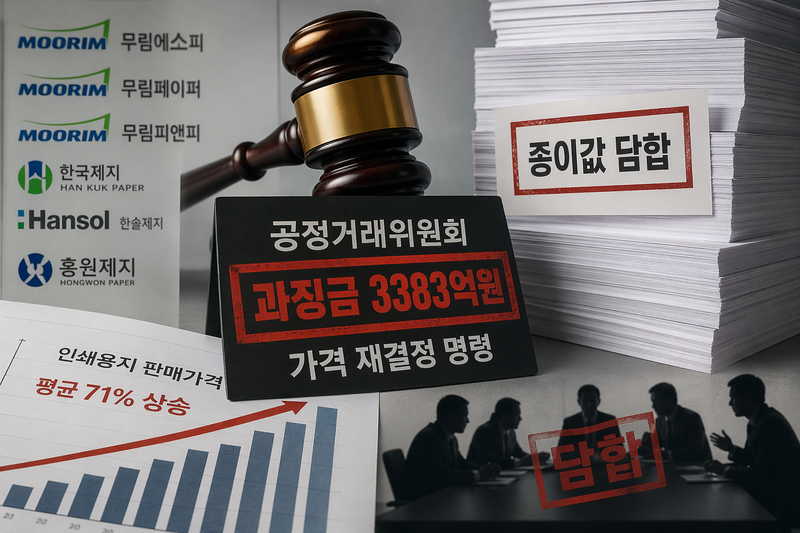
[The Financial News] Major domestic paper manufacturers that colluded on paper prices for 3 years and 10 months have been hit hard by the Korea Fair Trade Commission (KFTC). A total of 338.3 billion won in fines and a price reset order were imposed on six paper companies that account for 95% of the domestic printing paper market.
On the 23rd, the KFTC said it had imposed corrective orders, including a ban on future violations and an independent price reset order, as well as a total of 338.3 billion won in fines, on six printing paper makers — Moorim SP, Moorim Paper, Moorim P&P, Hankuk Paper MFG., Hansol Paper, and Hongwon Paper Mfg. — for agreeing to and carrying out price increases on all printing paper products from February 2021 to December 2024. It also decided to refer Hankuk Paper MFG. and Hongwon Paper Mfg. to prosecutors.
According to the KFTC, the companies met at least 60 times, both regularly and irregularly, over about 3 years and 10 months, and conspired on price increases seven times in total. The paper makers first set a benchmark price, which served as a list price, and then determined actual selling prices by applying discounts for each customer. In two cases, they raised the benchmark price directly, while in five cases they reduced discount rates.
Their collusion methods were also highly calculated. Company employees avoided using mobile phones registered in their own names and instead communicated through public phones, restaurant phones, and the mobile phones of employees from other departments. Contact information was managed separately on paper, using initials or aliases. To prevent customer backlash from concentrating on a single company, they even set in advance the order in which price increases would be announced. When agreement was not reached smoothly, they sometimes used dice to decide the order.
Vice Chairperson Nam Dong-il of the KFTC said, "Before the collusion began in 2021, profitability had deteriorated sharply due to cutthroat competition in the industry, and there were signs that the companies turned to collusion to recover." He added, "Paper is a capital-intensive industry with similar cost structures and limited product differentiation. The benchmark pricing system also appears to have acted as a structural factor that made collusion easier."
During the collusion period, domestic printing paper prices rose by an average of 71%. The paper companies secured stable profits, but the burden was passed on to distributors and end consumers, according to the KFTC.
The fine is the fifth-largest ever imposed by the KFTC in a cartel case and the largest ever in a paper industry collusion case. Based on related sales of 4.03 trillion won, the agency applied a 12% penalty rate to five companies and a 4% rate to one company.
The KFTC also ordered corrective measures to restore competition. Because the benchmark price for all customers had not changed even after the seventh and final agreement, it concluded that the effects of collusion were still lingering. Each company was ordered to independently reset the prices of printing paper products sold in South Korea to pre-collusion competitive levels. They must also report price changes to the KFTC every six months for the next three years. This is only the second such price reset order since the 2006 flour collusion case.
Vice Chairperson Nam added, "This measure is an active corrective action designed to bring prices back to competitive levels more quickly." He said, "We will continue to actively consider independent price reset orders whenever necessary."
[email protected] Kim Chan-mi Reporter