President Lee Asks Vietnamese Party Chief to Let Korean Companies Join High-Speed Rail and New Airport Projects
- Input
- 2026-04-23 00:31:52
- Updated
- 2026-04-23 00:31:52
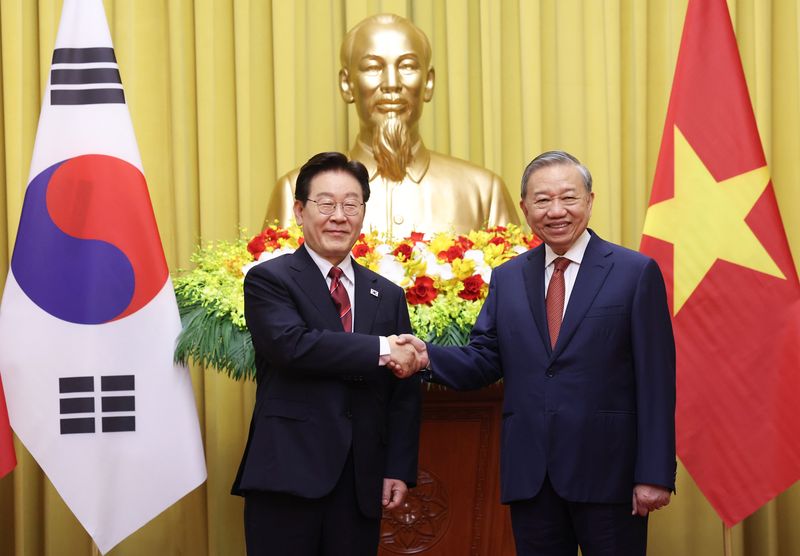
Kyuyoun Lee, senior presidential secretary for public relations and communications, said in a written briefing that day, "President Lee requested Korean companies' participation in large-scale infrastructure projects being pursued as part of Vietnam's national restructuring plan, including high-speed rail, new cities, and new airports."
Lee said, "Through this, I hope Korea can join Vietnam's journey toward becoming an advanced country as its best partner." Lam responded, "We hope to learn from Korea's experience for Vietnam's national development, and we hope that Korean companies with excellent technology and capabilities will contribute greatly to the development of Vietnam's national infrastructure." As a result, attention is also turning to possible cooperation in high-speed rail, the largest infrastructure project in Vietnam's history. The massive project will connect Hanoi and Ho Chi Minh City from north to south over a total length of 1,541 kilometers and cost about $67 billion, or roughly 100 trillion won. The operator selection process has recently moved into full swing.
Earlier, Lee also mentioned the achievements of Korea's urban rail exports during a joint press statement after the summit. Lee said, "Tomorrow, on the 23rd, a contract will be signed for Korea's export of rail cars for Ho Chi Minh City's urban rail system," adding, "I hope this contract will contribute to improving Vietnam's rail infrastructure and lead to expanded cooperation between the two countries in the large transportation and logistics infrastructure projects Vietnam is pursuing." Specifically, Hyundai Rotem Company, an affiliate of Hyundai Motor Group, will export the rail cars.
The two leaders also agreed to expand cooperation for energy security and supply chain stability. Lee stressed that he hoped the two countries could open a new horizon for strategic cooperation, including energy transition, through participation in Vietnam's new nuclear power plant construction and power infrastructure projects. Lam agreed, saying he hoped the two countries would further strengthen their energy security partnership and contribute to each other's sustainable development.
Kyuyoun Lee said the two sides also agreed to strengthen cooperation for supply chain stability by combining Vietnam's abundant resources with Korea's technology through the Korea-Vietnam Critical Minerals Supply Chain Center, which the two countries are jointly promoting.
Based on this, Lee and Lam shared the view that efforts to reach the $150 billion trade target by 2030 should be further accelerated.
They will also actively pursue cooperation in nuclear power. The two countries signed 12 memorandums of understanding on the day of the summit, including two related to nuclear power. One of them, the MOU on reviewing possible cooperation in nuclear power development, focuses on exploring plans for new nuclear power plant construction, jointly analyzing construction risks, and supporting the establishment of measures to optimize the construction schedule. The agreement is expected to help create a foundation for Korean companies to secure new nuclear power projects.
Lee also emphasized that predictable business conditions are important for Korean companies operating in Vietnam, and asked for special attention and cooperation to resolve difficulties such as value-added tax issues. Lam responded that he would spare no support needed to create a stable and friendly business environment for Korean companies.
Kyuyoun Lee said, "This state visit to Vietnam is part of a series of summit diplomacy toward ASEAN, following this year's visits to Singapore and the Philippines and the reception of Indonesia's president for a state visit to Korea. It can be seen as an opportunity to complete the best possible partnership with Vietnam, one of our key partners, across all areas including politics, the economy, and culture."
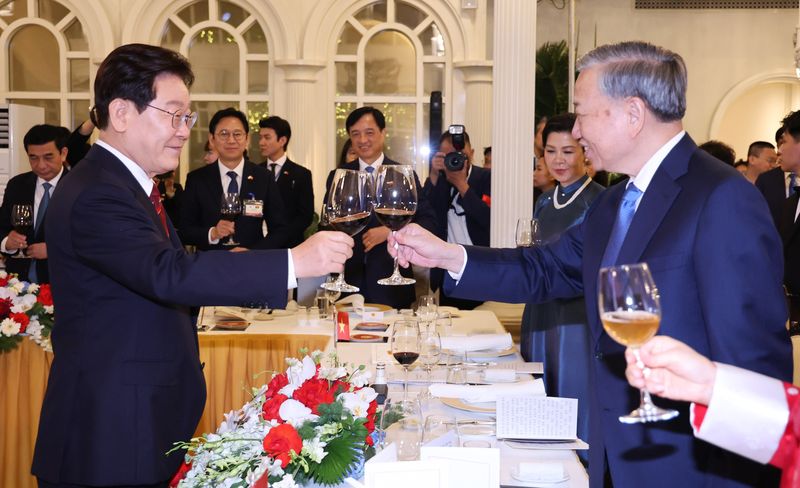
Meanwhile, Lee and Lam held a state dinner after their summit. Lam said, "Cultural similarities, political trust, and complementary economic development will be a solid foundation for Vietnam and Korea to continue their partnership as they work together toward a future of peace, stability, development, and prosperity," and created a warm atmosphere by saying "thank you" in Korean. Lee also greeted him with "Xin chao," and proposed a toast in Vietnamese, saying "Chuc suc khoe" meaning "to your health." He added that he hoped it would become a meaningful occasion to deepen the friendship and trust between the two countries.
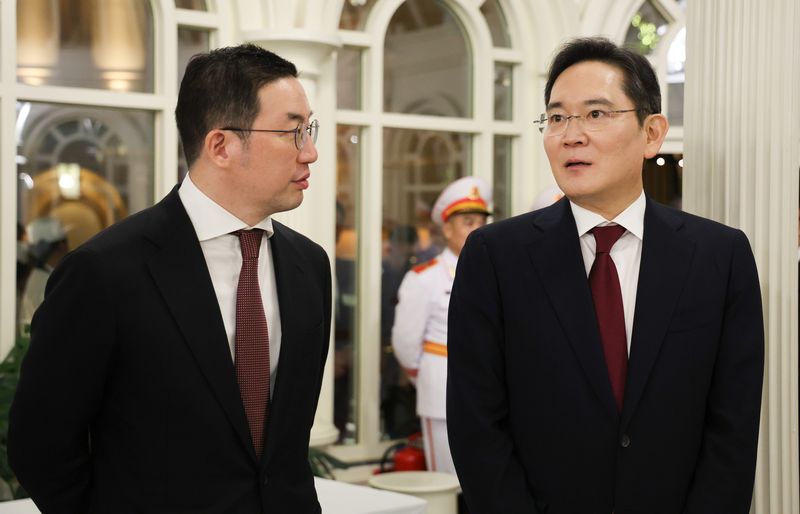
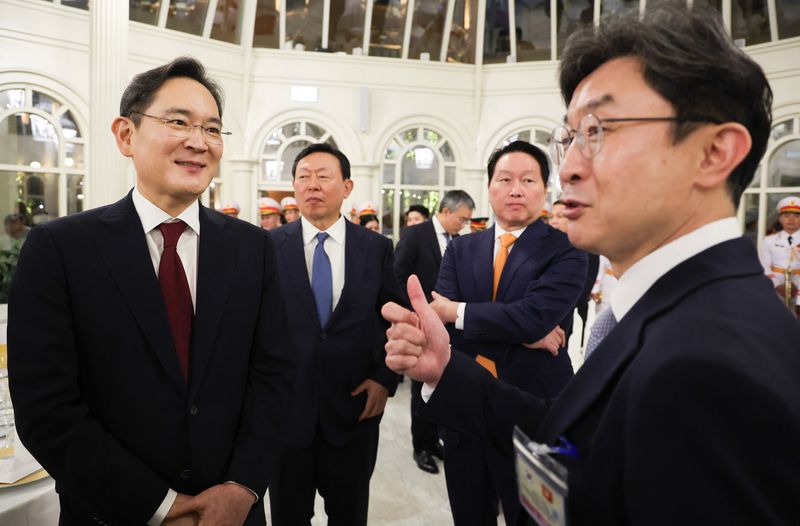
The state dinner was attended not only by the two leaders and their aides, but also by major business leaders from Korea, including Samsung Electronics Chairman Lee Jae-yong, Chey Tae-won, chairman of SK Group and head of the Korea Chamber of Commerce and Industry, Koo Kwang-mo, chairman of LG Group, Shin Dong-bin, chairman of Lotte Group, Chang In-hwa, chairman of POSCO, Chung Kisun, chairman of HD Hyundai, Huh Tae-soo, chairman of GS Group, Sohn Kyung Shik, chairman of CJ Group, and Cho Hyun-joon, chairman of Hyosung Group. The business leaders were also seen engaging in lively conversations with Vietnamese business figures.
[email protected] Choi Jong-geun Reporter