"Prices Rise, Economy Slows" ... Consumer Sentiment Index Falls Sharply
- Input
- 2026-04-23 06:00:00
- Updated
- 2026-04-23 06:00:00
According to the Bank of Korea (BOK)'s April 2026 Consumer Sentiment Survey released on the 23rd, the Composite Consumer Sentiment Index (CCSI) stood at 99.2 in April. That was down 7.8 points from 107.0 in the previous month. It fell below 100 for the first time in a year, since April last year, when it stood at 93.6. In terms of the size of the drop, it was the largest since December 2024, when the index fell 12.7 points.
The CCSI is a sentiment indicator calculated using six key sub-indexes from the Consumer Sentiment Index. The Consumer Sentiment Index is compiled from a survey of 2,500 households in urban areas nationwide on their views of economic conditions and expectations for future consumer spending. The survey was conducted from April 9 to 16.
The CCSI uses the long-term average from January 2023 to December 2024 as its benchmark of 100. A reading above 100 indicates optimism, while a reading below 100 indicates pessimism.
Lee Heung-hoo, head of the Economic Tendency Survey Team at the Economic Statistics Department 1 of the BOK, said, "The result reflects heightened concerns over rising prices and an economic slowdown amid energy supply disruptions and greater uncertainty at home and abroad." He added, "However, the index is still close to its long-term average."
Looking at perceptions of household finances, the Current Living Conditions CSI and the Consumer Sentiment Index for Future Living Conditions came in at 91 and 92, respectively, down 3 points and 5 points from the previous month. The Prospective Household Income Index and the Consumer Spending Outlook CSI both fell by 3 points to 98 and 108, respectively.
Perceptions of the economy worsened further. The Current Economic Assessment CSI and the Consumer Sentiment Index for Future Economic Conditions fell 18 points and 10 points from the previous month to 68 and 79, respectively. Both were the lowest since May last year, when they stood at 63, and April last year, when they stood at 73. In particular, the decline in the Current Economic Assessment CSI was the largest since December 2024, when martial law was declared, with a drop of 18 points.
The Employment Opportunities Outlook CSI fell 7 points to 82. The Interest Rate Outlook CSI rose 6 points to 115. That was the highest level in two years and five months, since November 2023, when it stood at 119. It has been revised upward every month since October last year, and has climbed 22 points over the past seven months.
In perceptions of household savings and debt conditions, the Current Household Savings Consumer Sentiment Index fell 1 point to 96, while the Household Saving Prospects CSI remained unchanged at 100. The Current Household Debt CSI was unchanged at 99, and the Household Debt Outlook CSI rose 1 point from the previous month to 98.
In perceptions of price conditions, the Consumer Price Outlook CSI rose 4 points from the previous month to 153, and the Housing Price Outlook CSI increased 8 points to 104. After easing to 96 in March, both indicators rebounded. The Expected Wage Level CSI was unchanged from the previous month at 120.
Perceptions of consumer price inflation over the past year were unchanged from the previous month at 2.9%. Expected inflation for the next year rose 0.2 percentage points from the previous month to 2.9%. For both the three-year and five-year horizons, the figure was 2.6%. Across all time frames, the largest share of responses was in the 2% to 3% range, at 26.9%, 29.5%, and 29.3%, respectively.
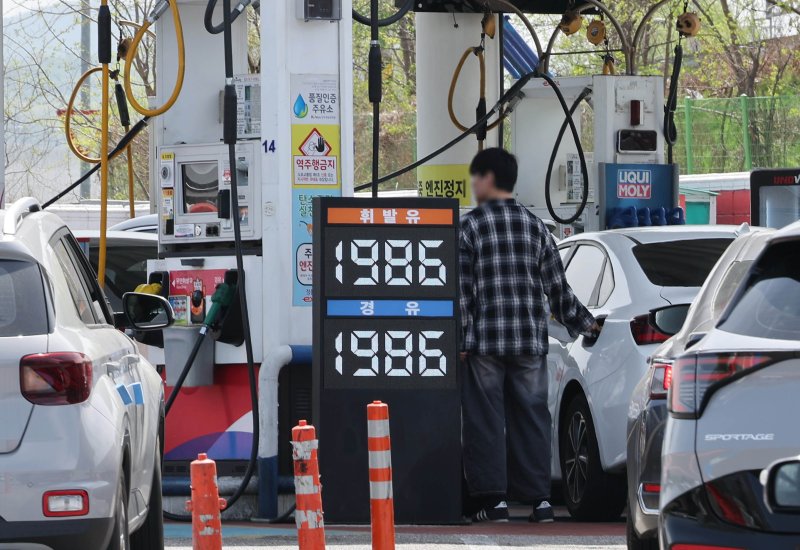
When asked which items would have the biggest impact on consumer price increases over the next year, respondents cited petroleum products first at 88.8%, followed by industrial goods at 33.1% and public utility charges at 31.4%. Compared with the previous month, the figures rose 8.7 percentage points and 9.9 percentage points, and fell 4.2 percentage points, respectively.
[email protected] Kim Tae-il Reporter