"4 Trillion Won to Cover Six Months of Losses" — Debate Over the Effectiveness of the Oil Price Cap System as KDI Says It Cut Inflation by 3%
- Input
- 2026-04-22 15:52:29
- Updated
- 2026-04-22 15:52:29
[The Financial News] Amid growing debate over the effectiveness of the oil price cap system, the Korea Development Institute (KDI), a state-run think tank, said the policy lowered consumer prices in March by as much as 0.8 percentage point. It also projected that the effect of the fuel tax cut, which will be fully reflected from this month, will be around 0.2 percentage point.
However, all losses incurred by oil refining companies under the oil price cap system are covered by the state budget. In the supplementary budget for the war response, more than 4 trillion won was allocated to compensate for six months of losses.
On the 22nd, KDI said in an emergency briefing from its task force on the Middle East war that both the oil price cap system and the fuel tax cut, introduced to respond to surging oil prices, had reduced consumer prices. The report was also a rebuttal to criticism that the fiscal spending had little effect on curbing oil inflation and consumption.
According to data released by National Data, consumer prices rose 2.2% in March. Petroleum products alone jumped 9.9%, the highest level in three years and five months since October 2022, when they rose 10.3%. If KDI's analysis is correct, the price cap system helped ease upward pressure on inflation in March.
In the case of the oil price cap system, KDI said the first price cap set on the 13th of last month lowered March consumer prices by 0.4 to 0.8 percentage point.
Based on the fourth week of March, the last week under the first price cap, the price reduction felt by consumers was estimated at about 460 won per liter for regular gasoline, 916 won for automotive diesel, and 552 won for indoor kerosene.
Ma Chang-seok, a senior researcher at KDI, said, "The price cap system directly regulates the upper limit of supply prices for oil refining companies, so the effect of lowering gasoline prices is structurally built in." In other words, because international oil prices are reflected in gas station prices with a time lag, the initial effect of the price cap is small, but it gradually expands over time.
The oil price cap system is a highly aggressive price-stabilization measure that directly controls the supply prices of oil refining companies, the upper tier of the distribution structure, on the premise of government fiscal support.
After setting the first price cap on the 13th of last month on a two-week cycle, the government plans to announce the fourth cap on the 24th. In the third announcement, it froze prices at the second-round level, with gasoline at 1,934 won per liter and diesel at 1,923 won per liter. The government said it will make its decision after taking into account global oil price trends, market impact, and the burden on the public.
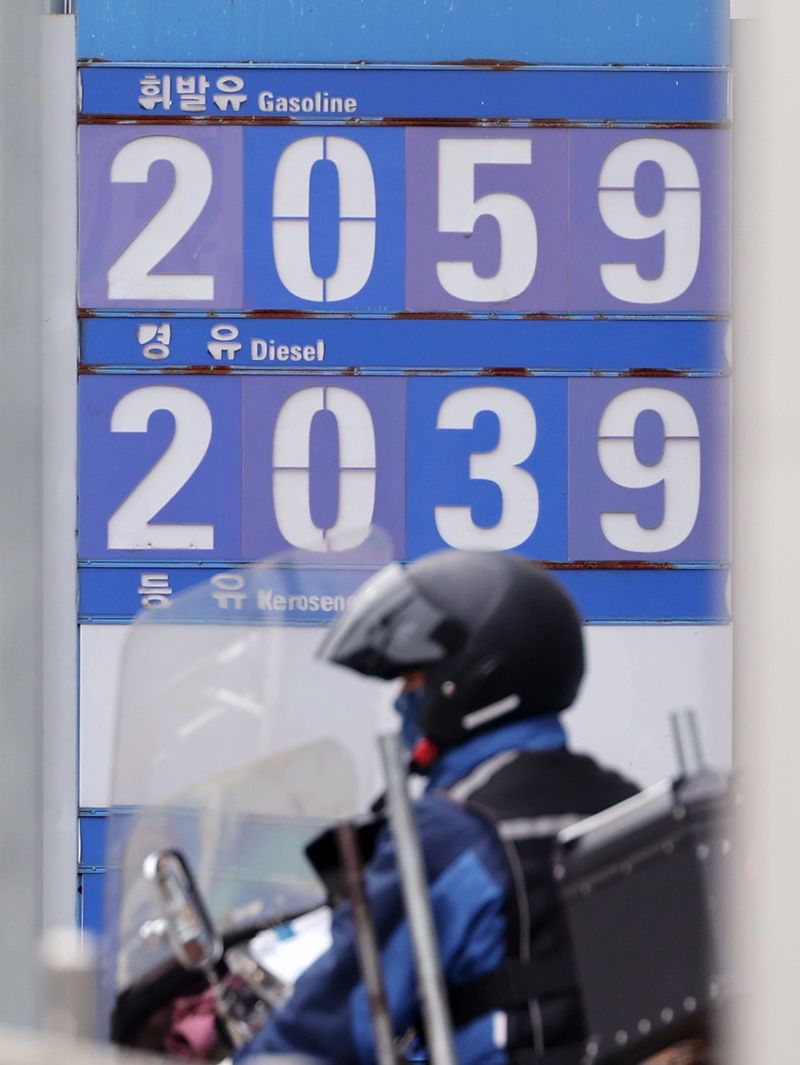
The nationwide average price of gasoline at gas stations has now exceeded 2,000 won per liter.
However, the oil price cap system has a flaw.
Because oil refining companies are reimbursed for their costs, they do not actually suffer major losses. From the consumer's perspective, the price increases for petroleum products do not feel large, so consumption does not fall significantly. Lee Jae-myung also said earlier, "We are in a situation where we need to reduce oil consumption, but in some cases consumption is actually increasing."
As high-income and heavy-use consumers continue using oil without reducing consumption, losses for oil refining companies grow, creating market distortions that require even more fiscal support. Although it is a direct response to high oil prices, if it continues for a long time, it will fail to curb oil consumption while government funds — in other words, taxpayers' money — keep going toward compensating oil refining companies for their losses.
In the case of the fuel tax, most of the reduction was reflected in lower gasoline prices.
Compared with the fuel tax cut on gasoline in November 2021, prices gradually fell after the measure took effect and eventually dropped at gas stations by an amount similar to the reduction itself, or 149.5 won. KDI said this is due to the structural characteristic of gasoline supply curves, which are close to horizontal.
[email protected] Jung Sang-gyun Reporter