KOSPI Composite Index Breaks Through 6,400... "Eyes 7,000 on Strong Earnings"
- Input
- 2026-04-22 16:01:32
- Updated
- 2026-04-22 16:01:32
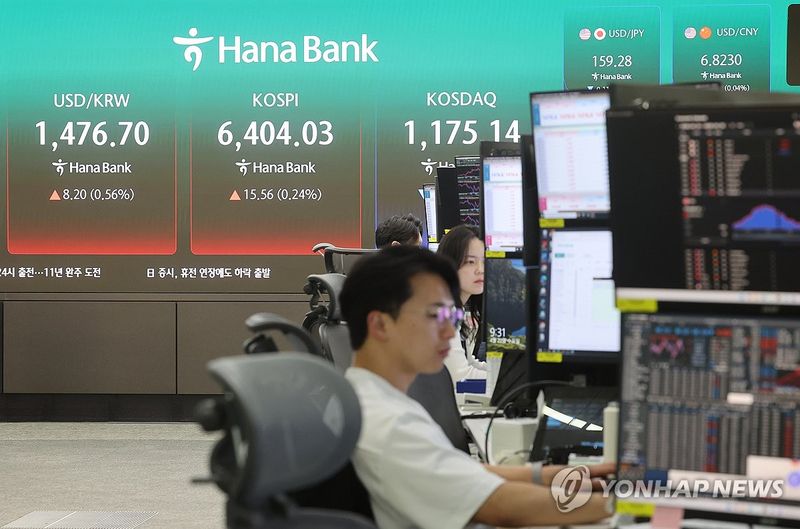
[The Financial News] The KOSPI Composite Index set a new all-time high for the second straight day after breaking through the 6,400 mark. Despite uncertainty over tariff negotiations, investor sentiment improved as expectations grew for stronger earnings at domestic companies, led by the semiconductor “big two.”
According to the Korea Exchange (KRX) on the 22nd, the KOSPI Composite Index closed at 6,417.93, up 29.46 points, or 0.46%, from the previous session. After rising to 6,388 points the day before and hitting a record, the index pushed to a new historic high for a second consecutive trading day. It opened at 6,387.57 and moved within a narrow range for most of the session, but afternoon buying by individual investors drove it past 6,400 for the first time. Retail investors bought 1.2365 trillion won worth of shares, while foreigners and institutions were net sellers of 680.7 billion won and 444.7 billion won, respectively. Compared with the 5,052.46 level on the 31st of last month, the index has surged 26.9% in just three weeks.
Semiconductor stocks slipped slightly, but major earnings plays moved higher. Battery-related stocks also rose, including LG Energy Solution (1.36%) and Samsung SDI (2.17%). Gains were also notable in HD Hyundai Heavy Industries (11.28%) and Samsung Electro-Mechanics (5.18%).
The KOSPI Composite Index has not only recovered to prewar levels but also moved above 6,400, largely because improving corporate earnings have eased some of the fear surrounding the war. According to the Korea Customs Service (KCS) report on import and export trends for April 1-20, exports rose 49% from a year earlier to $50.4 billion. Semiconductors drove the increase despite the fallout from the Middle East war.
As the market raised its expectations for first-quarter earnings reports, the KOSPI Composite Index gained further momentum. Samsung Electronics Co., Ltd. previously said its preliminary first-quarter operating profit jumped 755% from a year earlier to 5.72 trillion won. After that, the market raised its consensus estimate for SK hynix Inc.'s first-quarter operating profit to 36 trillion won as of the previous day, up from the 32 trillion won range earlier this month. Han Ji-young, a researcher at Kiwoom Securities Co., Ltd., said, "The KOSPI Composite Index's first-quarter operating profit consensus has also been revised slightly higher, from 133 trillion won earlier this month to 139 trillion won now, but actual market expectations appear to be looking for more than 139 trillion won."
Experts say it is difficult to dismiss the 6,000 level as overvalued, given the rapid growth in earnings per share (EPS) for listed Korean companies. The KOSPI Composite Index's 12-month forward EPS jumped 23.7% to 824.5 as of the 17th, from 666 at the end of last month. Corporate profits are rising quickly, but the index's 12-month forward price-earnings ratio (PER) stands at 7.55 times, less than half the U.S. level of 21.81 times. It is also cheaper than Japan's 17.81 times and China's 14.8 times. Industry sources say the market remains undervalued relative to developed economies, leaving room for further gains.
Attention is now turning to whether the market can reach the dream level of 7,000. Foreign brokerage firms see the government's stock market stimulus measures and semiconductor earnings as key positives for Korean equities. Goldman Sachs has therefore raised its 12-month target for the KOSPI Composite Index from 7,000 to 8,000.
Experts expect the KOSPI Composite Index to reach 7,000 no later than the second half of this year. Hwang Seung-taek, head of the Research Center at Hana Securities Co., Ltd., said, "It appears possible to reach the 7,000 level within the third quarter of this year." He added, "The biggest variables in the market right now are the possibility of a slowdown in semiconductor earnings and concerns over rising interest rates. In the end, the market has no choice but to turn toward stocks where earnings are secured and profits are visible. Now is the time to select structurally benefiting companies that are riding the artificial intelligence (AI) investment cycle on the back of strong earnings."
[email protected] Park Ji-yeon Reporter