Lee Jae-yong's 'bold bet on automotive electronics' pays off...Samsung's Harman doubles in size 10 years after acquisition
- Input
- 2026-04-22 13:03:29
- Updated
- 2026-04-22 13:03:29

■ Sales rise from 7 trillion won to 15 trillion won...numbers tell the storyAccording to Samsung on the 22nd, Harman's sales, which stood at 710.34 billion won in 2017 shortly after the acquisition, surpassed 10 trillion won in 2019 and topped 15 trillion won again last year. That means the company has grown more than twofold in 10 years. In 2025, both sales and operating profit hit record highs, with operating profit reaching 1.5311 trillion won and the operating margin coming close to 10% at 9.7%. The company is now the global No. 1 in core automotive electronics components such as digital cockpits and car audio.
In 2025, automotive electronics accounted for an estimated 65% to 70% of Samsung Harman's sales. Harman is not only regarded as a powerhouse in audio, outperforming rivals such as Sony and Bose, but also stands shoulder to shoulder with global companies ranked in the top 40 in the automotive electronics sector, where sales are estimated at 10 trillion to 11 trillion won.
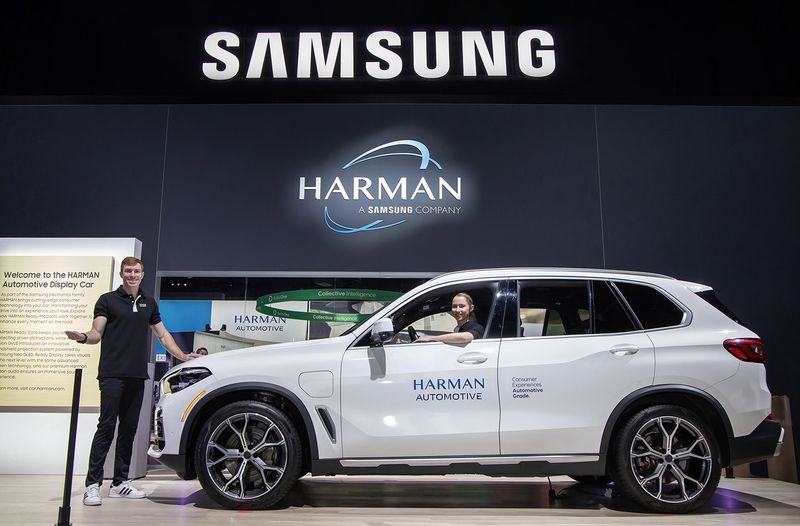
Back in 2016, Samsung Electronics Chairman Lee Jae-yong identified automotive electronics as Samsung's next growth engine and made the bold decision to acquire Harman. Harman's growth was made possible by the organic combination of Samsung's advanced hardware capabilities and Harman's network in the automotive industry. Lee believed that in the future mobility market, where infotainment and autonomous driving converge, automotive components would become more than simple parts and instead serve as the core of the user experience.
In fact, Harman's solutions are being advanced by combining them with Samsung Electronics' 5G communications technology, Exynos Auto Chip, and Samsung SmartThings platform to deliver more sophisticated connected-car features. Harman's audio expertise is also being applied across Samsung Electronics' TVs, home appliances, mobile devices, and other finished products, becoming an invisible force that enhances product competitiveness.
Harman, for its part, has further strengthened its position in the global market by securing Samsung's stable manufacturing base and supply chain. Samsung Electronics has also built a long-term foundation for expanding its technological capabilities in smart car and smart home businesses by raising the market share of the Exynos Auto Chip and Samsung SmartThings platform through collaboration with Harman's automotive electronics solutions.
At the end of last year, Samsung Harman acquired the advanced driver assistance system business of German automotive electronics company ZF for 1.5 billion euros, or about 2.6 trillion won, to strengthen its autonomous driving capabilities. ZF's ADAS business is the world's No. 1 in smart camera modules for autonomous driving.
[email protected] Jo Eun-hyo Reporter