KDI: Oil Price Cap Cut March Inflation by as Much as 0.8%
- Input
- 2026-04-22 10:02:49
- Updated
- 2026-04-22 10:02:49
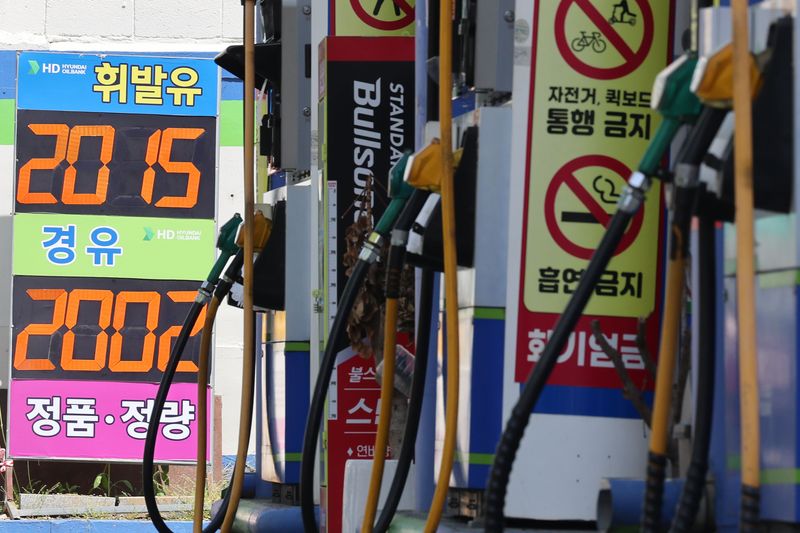
[The Financial News] The state-run Korea Development Institute (KDI) said the oil price cap lowered March consumer prices by as much as 0.8 percentage point. It also projected that the fuel tax cut, which will be fully reflected from this month, will reduce inflation by about 0.2 percentage point. March consumer price inflation stood at 2.2%. In particular, petroleum product prices jumped 9.9%, the sharpest increase in three years and five months since October 2022, when they rose 10.3%.
On the 22nd, KDI released an emergency briefing from its Middle East War Response Task Force outlining these findings.
KDI said both the oil price cap and the fuel tax cut, introduced to respond to surging crude prices after the escalation of the Middle East war, had the effect of lowering consumer prices.
In the case of the price cap, KDI said the first round of capped prices reduced March consumer prices by 0.4 to 0.8 percentage point. Based on the final week of the first price cap, the fourth week of March, it estimated that consumers felt price reductions of about 460 won per liter for regular gasoline, 916 won for automotive diesel, and 552 won for indoor kerosene.
Ma Chang-seok, a senior researcher at KDI, said, "The price cap directly regulates the ceiling on refinery supply prices, so the effect of lowering gasoline prices is structurally built in." In other words, because international oil prices are reflected at gas stations with a time lag, the initial effect of the price cap is small and then gradually expands.
As for the fuel tax cut, most of the reduction was passed through to lower gasoline prices.
Compared with the gasoline fuel tax cut in November 2021, prices began to fall gradually immediately after the measure took effect, and gas station selling prices ultimately dropped by an amount similar to the tax cut of 149.5 won.
KDI said this is due to the structural characteristics of gasoline supply, where the supply curve is close to horizontal. It explained that gasoline can be exported to the global market at any time by refiners, which helps increase the pass-through of tax cuts to consumer prices.
However, KDI said no statistically significant slowdown in consumption has been observed since the outbreak of the Middle East war. It added that continued monitoring is needed, including any decline in total mobility related to broader economic activity.
Taking into account the regressive structure in which lower-income households spend a larger share of income on energy, KDI recommended establishing an energy support system tailored to household characteristics in response to high oil prices.
Lee Young-wook, a senior researcher at KDI, said, "Households not receiving benefits under the National Basic Livelihood Security System (NBLSS) actually face a heavier energy burden, so differentiated support based only on NBLSS eligibility has limits." He added, "Households engaged in farming and simple labor in the transport sector, including delivery and freight drivers, are more exposed to oil price shocks."
He also said, "If high oil prices persist, low-income households could face a relatively larger increase in housing and heating costs during the summer. Preparations are needed, including support for essential goods through the Geunyang Dream Center and emergency energy assistance linked to heatwave alerts."
[email protected] Jung Sang-gyun Reporter