"Political Expediency" Draws Fire from USFK Commander as Lee Jae-myung Administration Faces Risk of Early OPCON Transfer in Two Years
- Input
- 2026-04-22 08:55:15
- Updated
- 2026-04-22 08:55:15
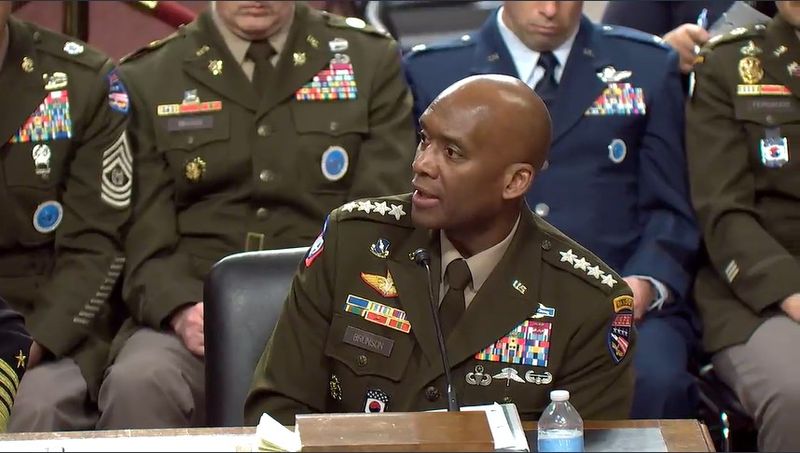
General Xavier T. Brunson appeared before the United States Senate Armed Services Committee on the 21st local time and said, in reference to the transfer of wartime operational control between South Korea and the United States, that "political expediency should not outrun conditions." He added, "We need to focus on the conditions. That is how the United States becomes safer, and how South Korea becomes safer." There had been widespread expectations that the Lee Jae-myung administration would complete the OPCON transfer in 2028, before the end of U.S. President Donald Trump's term. But Brunson's remarks, which appeared to suggest that conditions have not yet been met, have raised concerns that the timing of the transfer could be pushed back further.
To transfer OPCON, South Korea must meet a range of conditions, including command and control, intelligence, surveillance and reconnaissance (ISR), precision strike capabilities, and the ability to conduct combined operations, as well as comprehensive capabilities to respond to North Korea's nuclear and missile threats.
Questions have recently been raised over whether South Korean forces have the comprehensive capability to respond to North Korea's nuclear and missile threats. Those concerns intensified after Minister Chung restricted the sharing of information on North Korea with the United States following controversy over the alleged leak of classified information related to a third North Korean nuclear facility.
As confusion grew, even the Ministry of National Defense of the Republic of Korea and the Ministry of Foreign Affairs of the Republic of Korea stepped in to explain that there was no problem with ROK-U.S. coordination. The defense ministry also unusually said that coordination between the two allies had proceeded smoothly when North Korea fired its so-called "devil's missile." If the United States does not share classified information on North Korean missile launches, a rapid response becomes difficult. There were also claims that Brunson had protested Minister Chung's alleged leak to Defense Minister Ahn Gyu-back, but the defense ministry immediately denied them.
In addition, concerns have been raised at home and abroad that deterrence against North Korea could be weakened as key USFK assets have been pulled out of the Korean Peninsula and redeployed to the Middle East after the recent war there. A USFK redeployment is widely seen as likely if OPCON is transferred.
When Democratic Party lawmaker Gary Peters asked how removing THAAD from the Korean Peninsula and redeploying it to the Middle East would affect deterrence against North Korea, Brunson replied, "No THAAD system has been moved. THAAD is still on the Korean Peninsula." He added, "We are sending ammunition, and it is standing by for movement."
In peacetime, operational control of South Korean forces rests with the chairman of the Joint Chiefs of Staff, a four-star South Korean general. In wartime, it is held by the commander of the ROK-U.S. Combined Forces Command, a four-star U.S. general. If OPCON transfer is realized, a four-star South Korean general would exercise operational control over the combined forces even in wartime.
The OPCON transfer requires evaluation and verification in three stages. The process is now in the second stage, verification of Full Operational Capability (FOC). South Korea and the United States plan to complete the FOC verification before the 58th ROK-US Security Consultative Meeting (SCM) in Washington, D.C. in October and seek approval from the two defense ministers at that meeting. At the SCM, the defense ministers of both countries are expected to present a target year for the OPCON transfer.
[email protected] Kim Kyung-soo Reporter