USFK Commander Says Wartime Operational Control Transfer Must Be Based on Conditions, Not Political Convenience
- Input
- 2026-04-22 06:05:29
- Updated
- 2026-04-22 06:05:29
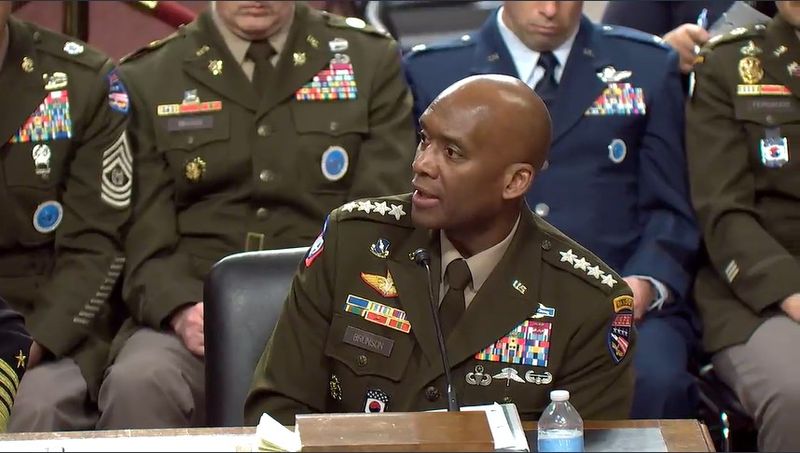
[The Financial News] General Xavier T. Brunson, commander of USFK, formally denied allegations that the U.S. government had moved the Terminal High Altitude Area Defense (THAAD) system deployed in South Korea to the Middle East in response to Iran. He did say, however, that "munitions," including THAAD interceptor missiles, are currently awaiting shipment to the Middle East.
Speaking at a Senate Armed Services Committee hearing in Washington, D.C., on the 21st local time, Brunson gave that answer when asked whether USFK assets were being redeployed to the Middle East.
Concerns have recently been raised that the DoD is pulling USFK assets, which are meant to counter North Korean threats, to support a war with Iran. Brunson drew a clear line in response.
Brunson stressed, "We have not moved any THAAD system. THAAD remains on the Korean Peninsula."
He added, "We are currently sending munitions forward, and those munitions are awaiting movement."
He did not specify the exact type of "munitions," but the context suggests he was referring to the missile interceptors that are central to the THAAD system.
Earlier, foreign media outlets including The Washington Post (WP) reported that The Pentagon was moving some THAAD components from USFK to the Middle East, raising concerns that deterrence against North Korea could be weakened.
Brunson also reaffirmed a cautious stance on the transfer of wartime operational control, one of the biggest pending issues between South Korea and the United States.
He emphasized, "Political convenience must not come before the 'conditions' for transferring wartime operational control." The remark suggests that the U.S. military continues to adhere to the principle of a conditions-based transition, despite the Lee Jae-myung administration's push to complete the transfer within its 2030 term.
South Korea and the United States are reportedly reviewing a plan to set 2028 as the target year for the transfer at the annual Security Consultative Meeting (SCM), which is scheduled to be held in Washington this fall.
At the hearing, Brunson also said that when it comes to the possibility of reducing USFK troop levels, he would focus on "capability" rather than numbers.
He said, "USFK is being modernized to respond to rapidly changing strategic dilemmas," adding, "My focus is on capabilities, not numbers."
The comment is interpreted as underscoring that, just as important as maintaining the size of USFK, is whether the assets stationed on the Korean Peninsula actually possess precise strike and defense capabilities, which are at the core of deterrence.
[email protected] Yoon Jae-jun Reporter