[Editorial] K-Battery Wins Bring Good News on Orders; It Should Seize the Lead with Technology and Persistence
- Input
- 2026-04-21 19:06:27
- Updated
- 2026-04-21 19:06:27
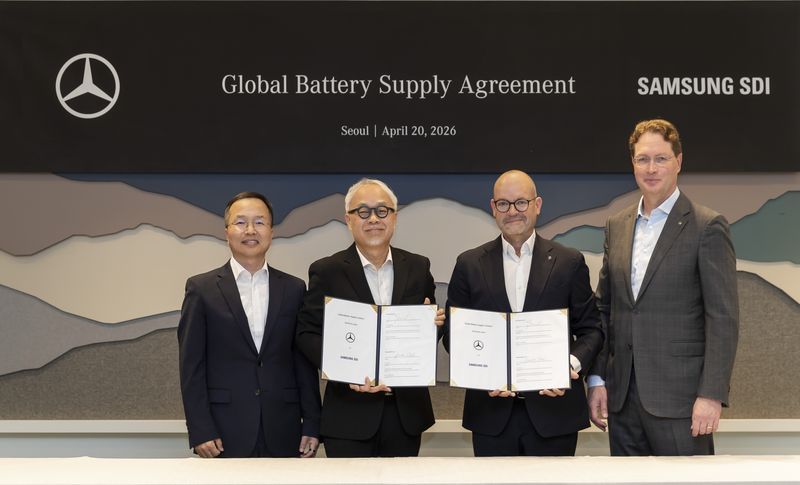
Some analysts say the deal was also driven by Lee Jae-yong's hands-on sales efforts. The chairman met closely with Mercedes-Benz leadership in November last year and again last month to discuss strategic ties, including a battery alliance. Even amid fears of an electric vehicle slowdown, Samsung quietly focused on technology development and network expansion, and that persistence has now produced valuable results.
LG Energy Solution's additional order is also noteworthy. Starting in 2028, LG Energy Solution will supply Mercedes-Benz with lithium iron phosphate (LFP) batteries for seven years in a deal worth 260 billion won. In the mid- and low-priced mass-market segment, Chinese companies dominate the European market for LFP batteries. LG Energy Solution had focused on high-performance batteries for premium electric vehicles, but it has recently expanded its lineup to include lower-cost LFP products. Including existing orders, LG Energy Solution's supply volume for Mercedes-Benz has grown to the 25 trillion won range. Being late to LFP is regrettable, but if it makes the most of today's opportunity with technology and persistence, it still has a strong chance to succeed.
The global battery market was once led by Japan, then lost its edge to Korea, and now faces intense low-price competition from China. Korean battery makers were caught in a wave of crisis for a time as slowing electric vehicle demand added to the pressure, but they held firm through technology and determination and are now starting to turn the engine back on for a comeback. As higher oil prices boost electric vehicle demand and artificial intelligence-driven demand for Energy Storage System (ESS) batteries grows, the battery market is gaining momentum again. According to industry sources, the global electric vehicle battery market in 2030 is expected to be about 90% larger than last year, while the ESS battery market is projected to surge by as much as 160%. Korea must prepare actively for the new shape of the battery market.
The European Union (EU) has announced the Industrial Acceleration Act (IAA) and tightened regulations on strategic industries such as batteries and electric vehicles. Some provisions also require carbon emissions reporting and impose disadvantages on companies that receive subsidies from abroad. While this works against Chinese firms, it could create opportunities for Korean companies. The IAA openly calls for production within Europe. The United States, which enacted the Inflation Reduction Act (IRA), is doing the same. Without local production capacity, companies will face significant limits on market access. Securing technology and ecosystems is the key.
Batteries should be seen not as a simple manufacturing industry, but as a complex sector that combines resources and technology. The public and private sectors must work together to secure stable mineral supplies and build a recycling ecosystem. Korea, China, and Japan are ahead in the development of next-generation all-solid-state battery technology, while U.S. startups are emerging as a variable in the race. The world is watching closely to see who will be the first to commercialize it. Competition over driving range, safety, and performance will be fierce. We hope Korean companies will continue to fight hard.