"Eating less and going vegetarian won't make you live longer"...If you want to live to 120 [fn Insight]
- Input
- 2026-04-21 16:08:18
- Updated
- 2026-04-21 16:08:18
\rIn an era when the term "super-aged society" is no longer unfamiliar, how should we grow old? Beyond simply living longer, interest is rising in how to end life healthily and with dignity — a way of "growing old with grace." For longevity scientist Park Sang-chul, a chaired professor at Chonnam National University (CNU), aging is not a passive stage on the way to death. It is an active process in which cells do their best to survive. Park stresses that postnatal effort matters more than genetics when it comes to longevity.\r\n
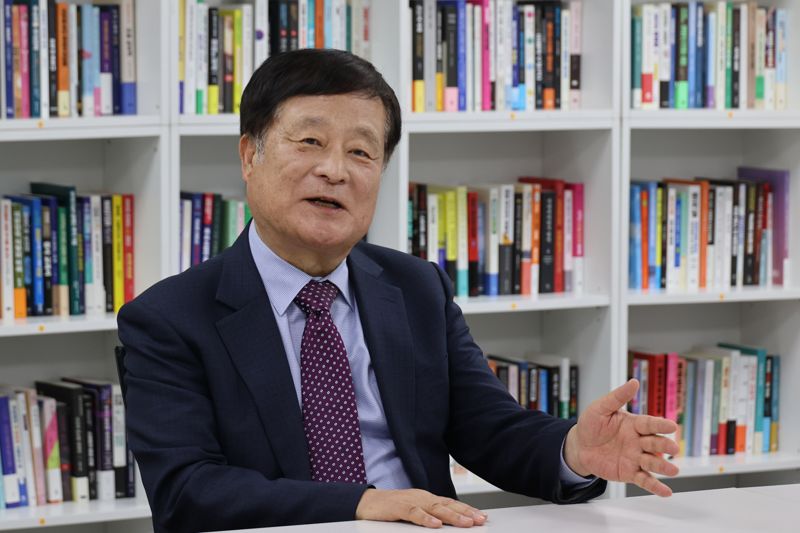
\r\n[The Financial News] Park Sang-chul, a chaired professor at Chonnam National University (CNU) whom The Financial News editorial writer Noh Dong-il met on the 21st, presents a new perspective on aging. He also offers advice on the secrets of longevity and how to grow old with grace. In his view, eating less or going vegetarian does not automatically lead to a longer life. Instead, people should aim for "Confident Aging," marked by moderation and openness. The full conversation is available on The Financial News YouTube channel, fn Insight.\r\n
\r\n

Aging is not a process of dying
\r\n\r\nWhat happens when strong ultraviolet rays or poison are applied to young and old cells? Young cells responded by quickly receiving both good and bad signals into the nucleus and either proliferating or dying. Old cells, by contrast, showed poor signal transmission, so they could not proliferate but also did not die.
\r\nWhile conducting the experiment, Professor Park Sang-chul explained, "Aging is related to problems in the signal transmission system." He added, "This shows that aging is not simply a process of dying, but a process in which living organisms do their utmost to protect life as they go through life."
\r\nIn that sense, aging can be redefined not as a "process of dying," but as a "noble effort to preserve survival."
\r\nPark added, "Just as the universe has continued without rest since the Big Bang, every cell in our body also does its best to protect life until the final day it dies." He continued, "Even amid changes in the external environment or declines in function, our bodies have an astonishing ability to keep vital indicators such as blood pressure, blood sugar and body temperature stable. This reveals the essence of living organisms: they constantly strive to protect themselves."
\r\n
\r\n
\rChoose balanced meals over eating less, and participation over rest\r\n
\r\n\r\nPark also criticized the common belief that longevity is heavily determined by genes. He said, "In identical twin studies, genes account for only about 25% of the effect on longevity, while the remaining 75% comes from acquired factors." He argued, "It is wrong to ignore your own lifestyle and assume you will live long just because your grandfather or father did. Rather than relying heavily on genetics alone, postnatal effort is far more important."
\r\nPark said, "There is a common belief that eating less is good for longevity, but what matters is an 'Optimal Diet' — eating appropriately." He added, "Excessive restriction can weaken immunity and impair various bodily functions. If you insist on vegetarianism alone, you may become deficient in nutrients such as Vitamin B12, so it is important to eat both plant-based and animal-based foods in balance." He noted that Korea's traditional diet can address Vitamin B12 deficiency through fermented foods such as Doenjang, soy sauce and Cheonggukjang.
\r\nAnother common trait among long-lived people is that they keep working. This does not necessarily mean earning money; rather, they continue what they have always done or find new meaning in life. Park Sang-chul advised, "In rural communities, it may be possible to keep doing the same work, but in urban white-collar jobs, it can be difficult to find something new." He added, "You should try hobbies or learn new things such as Artificial Intelligence (AI), while making efforts to maintain relationships with others."
\r\nPark presented three principles for a confident old age: Do (active participation), Share (giving and contribution), and Learn (continuous learning). He said, "Henry Alfred Kissinger studied AI and wrote a book at the age of 95." He urged people not to stand still as they grow older. "In a changing world, you need to find what you should do and live an actively 'Becoming' life. With the mindset that it is 'Never Too Late,' it is important to try change even now."
\r\n
\r\n

\r\n
fair@fnnews.com Han Young-joon Reporter