"Summarize the YouTube livestream I'm watching now"... Google brings Gemini to Chrome [IT Item of the Day]
- Input
- 2026-04-22 07:00:00
- Updated
- 2026-04-22 07:00:00
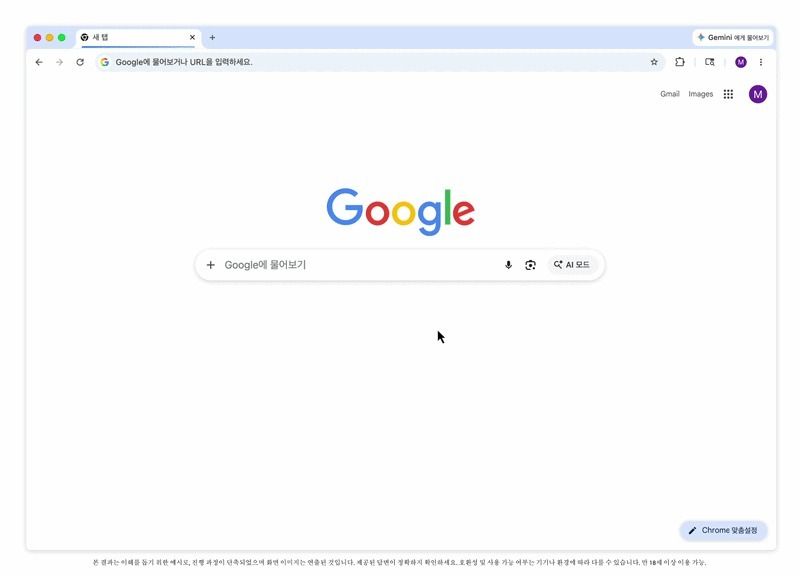
[Financial News] Google has officially launched "Gemini in Chrome" in South Korea, integrating its generative AI, Google Gemini, into its web browser, Google Chrome. The strategy is designed to increase user engagement and lock users into the Google ecosystem by letting them handle everything from everyday web browsing to complex work research directly in the browser.
According to the industry on the 22nd, Google has been rolling out an updated version of Chrome powered by its latest AI model, Gemini 3.1, across South Korea and the Asia-Pacific (APEC) region since the previous day. The update is aimed at improving web search and usability.
With "Gemini in Chrome," users can click the star-shaped Gemini logo in the upper-right corner of the browser window to open a small chat box. Through it, they can ask questions about the content on a website.
The update allows users to work more efficiently on a single screen. Instead of switching between multiple tabs, they can use Gemini built into the side panel to instantly summarize the webpage they are reading or extract key information.
AI can remember the context of pages visited in the past, reducing the need to keep multiple windows open unnecessarily. Gemini can understand not only text in Chrome tabs, but also images and video, and it remembers user information to provide personalized responses.
Through "Gemini in Chrome," Google can connect its core services, including Gmail, Google Maps, Google Calendar and YouTube, into one ecosystem. Users can draft emails or even ask for a summary of the YouTube livestream they are watching in real time.
Google's latest image-generation AI model, Gemini 2.5 Flash Image, is also built into Chrome. Without a separate image-editing program or file upload process, users can make instant image transformations in the browser simply by entering a text prompt in the side panel.
After trying it firsthand, the reporter found it convenient to ask Gemini directly whenever a question came up while viewing a webpage.
It was possible to issue commands such as "Summarize the Middle East issue related to the current page article" without leaving the tab. The browser could also recognize multiple article tabs, then summarize, compare and analyze the contents of each page. However, when the reporter clicked an article link Gemini had recommended as a reference, it sometimes led to a "page not found" error.
Google said it has built in safeguards from the design stage to ease security concerns over expanded AI convenience. The company also plans to add more features within the year and continue expanding language and country support.
Meanwhile, efforts to integrate AI features into browsers are becoming increasingly common both in South Korea and abroad.
Examples include OpenAI's "ChatGPT Atlas" and Perplexity AI's "Comet," while in South Korea there is Samsung's "Samsung Internet Browser," developed in collaboration with Perplexity AI. In addition, Naver Corporation's "Naver Whale" and Upstage Co., Ltd. are also being mentioned as potential entrants to the AI browser market after Kakao Corp. acquired the portal Daum.
[email protected] Joo Won-gyu Reporter