Government says CU-Cargo Truckers Solidarity dispute has gone beyond the Yellow Envelope Law; labor groups demand subcontractor bargaining rights
- Input
- 2026-04-21 15:08:04
- Updated
- 2026-04-21 15:08:04
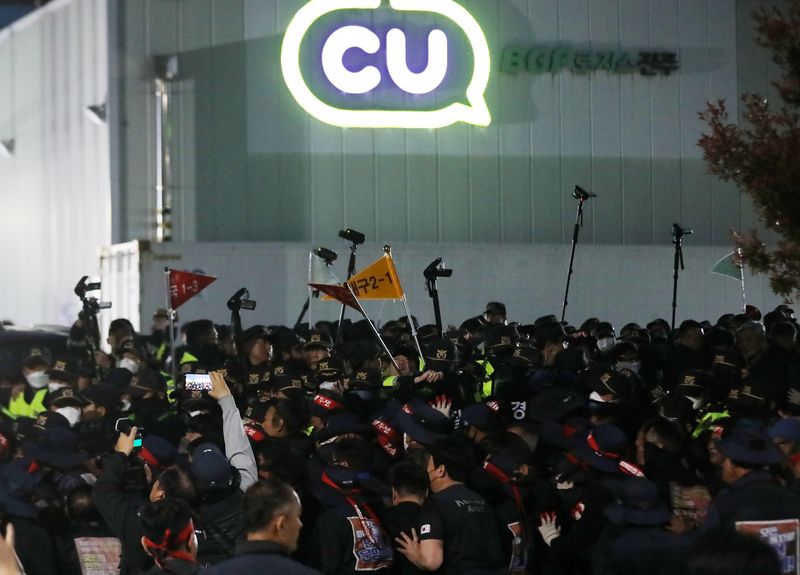
The Ministry of Employment and Labor (MOEL) said on the 21st that the casualties, including union members, that occurred during the standoff at the CU Jinju Logistics Center in Jinju City, South Gyeongsang Province, on the 20th, were "a situation that goes beyond the issue of bargaining between prime contractors and subcontractors under Article 2 of the revised labor union law, based on substantial and specific control."
MOEL added that "the root cause is that no structure has been put in place for people in relatively vulnerable positions, such as small business owners and individual entrepreneurs, to unite and demand dialogue," and that it was "regrettable that the conflict was not resolved smoothly through dialogue and instead worsened."
The ministry was seen as drawing a line against interpretations that the implementation of the Yellow Envelope Law had intensified conflict between prime contractors and subcontractors and led to the incident.
MOEL added that, together with other ministries, it will seek ways for small business owners and self-employed workers in vulnerable positions to communicate and engage in dialogue with stakeholders to protect their own rights and interests.
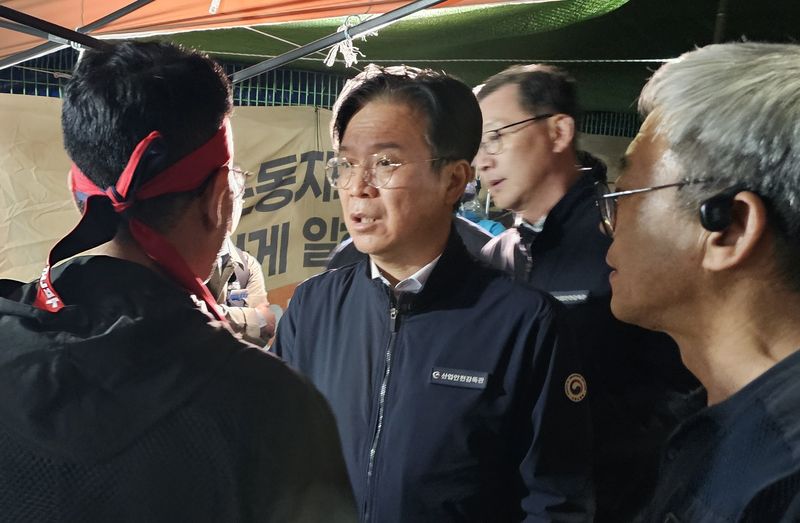
The KCTU, a party to the dispute, argued that the tragedy was caused when BGF Retail, the prime contractor, refused legitimate bargaining and illegally used replacement workers. It also urged the government to "move immediately to resolve the situation."
The KCTU also said that "BGF Retail must acknowledge its responsibility as the prime contractor, apologize immediately, and enter into negotiations," adding that "the government must effectively guarantee subcontracted workers' bargaining rights in line with the purpose of the revised labor union law."
The FKTU also called on the government to uncover the facts and punish those responsible.
In a statement, the FKTU said the incident was "an inevitable result of labor realities in which there is no real bargaining structure within a multi-tier subcontracting system," and that "the employer's eagerness to avoid negotiations, along with the authorities' passive response, ultimately took a precious worker's life."
It rejected claims that the Yellow Envelope Law triggered the incident, calling them "nothing more than a blame-shifting attempt that distorts the essence of the issue."
The FKTU argued that the Yellow Envelope Law is "a minimum safeguard to ensure meaningful bargaining rights for subcontracted and specially employed workers and to clarify the responsibility of prime contractors as employers," adding that "the problem is that, despite the law's purpose, prime contractors that exercise actual control on the ground have continued to evade negotiations and deny their status as employers."
[email protected] Kim Jun-hyeok Reporter