[Exclusive] Performance and Localization Clash Over Missiles for the KF-21
- Input
- 2026-04-22 16:02:45
- Updated
- 2026-04-22 16:02:45
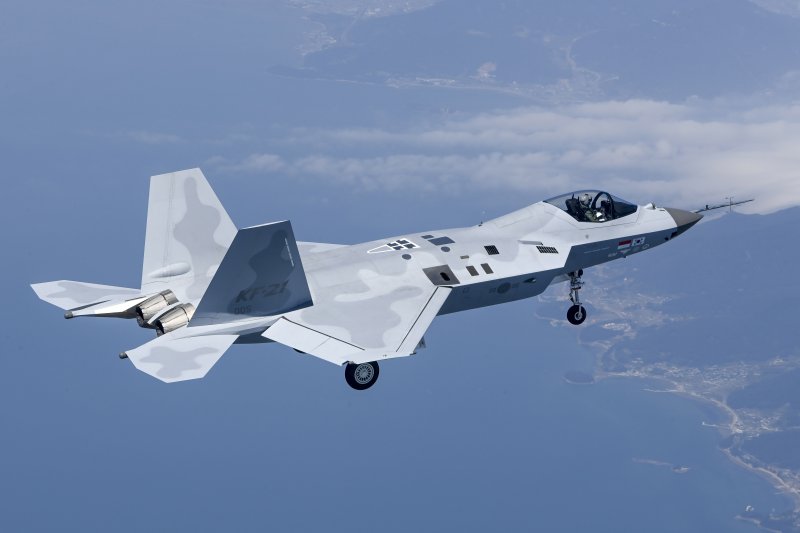
[The Financial News] A sharp conflict has emerged between performance and localization over the KF-21’s key weapon system, as the next-generation Korean fighter prepares for its first export.
The Meteor long-range air-to-air missile mounted on the KAI KF-21 Boramae weighs 407 pounds, or about 185 kg, per unit. However, the missile designed by the Agency for Defense Development (ADD) weighs 450 pounds, or about 205 kg, making it more than 40 pounds, or 20 kg, heavier. ADD is pursuing a project to develop a long-range air-to-air missile for the KF-21 that would match the Meteor or the AIM-120 Advanced Medium-Range Air-to-Air Missile (AMRAAM), with development currently targeted for 2033. If a new launcher is built to carry the heavier missile, slower maneuvering and reduced missile range would be unavoidable.
According to the government and industry on the 22nd, the first mass-produced KF-21 will be delivered starting this year with Meteor missiles installed. However, discussions are reportedly continuing within the military over whether ADD should keep pushing ahead with its plan to develop a domestically produced long-range air-to-air missile targeted for 2033. ADD has recently been confirmed to have visited missile launcher manufacturers in the United States and the United Kingdom with government officials to discuss mounting the domestic missile.
Four long-range air-to-air missiles are mounted on each KF-21. If the domestically developed missile is installed in the future, the aircraft would need to withstand nearly 100 kg more weight than with the Meteor missile developed by Europe’s MBDA. In that case, government officials say the KF-21’s maneuvering speed, currently around Mach 1.8, would be significantly reduced, and the aircraft’s own performance would inevitably suffer during production.
Sources said some at ADD and within the Air Force have argued that the fuel loaded into the missile should be reduced to cut its weight. But reducing the fuel would inevitably shorten the missile’s range.
In connection with the issue, ADD recently visited U.S. company Marvin Test Solutions and Britain’s Eaton Corporation, both missile launcher manufacturers, together with Air Force and DAPA officials, to discuss the matter. DAPA says modifying or developing a launcher is outside the current scope of the project, but the situation could change if the Air Force and the Ministry of National Defense of the Republic of Korea accept ADD’s request.
An ADD official said, "We are still before the start of the system development project, and we will develop it in line with the military’s requirements."
Meanwhile, government and industry sources pointed out that changes to the airframe structure may be needed to create a configuration suitable for the domestic missile. In that case, the KF-21 design, analysis, ground tests, and flight tests may all have to be carried out again.
hoya0222@fnnews.com Kim Dong-ho Kim Hak-jae Kim Dong-chan Reporter