Defense exports hit $15.44 billion, with a production-inducing effect of 46.4 trillion won..."Economic ripple effects are now taking hold"
- Input
- 2026-04-21 14:22:43
- Updated
- 2026-04-21 14:22:43
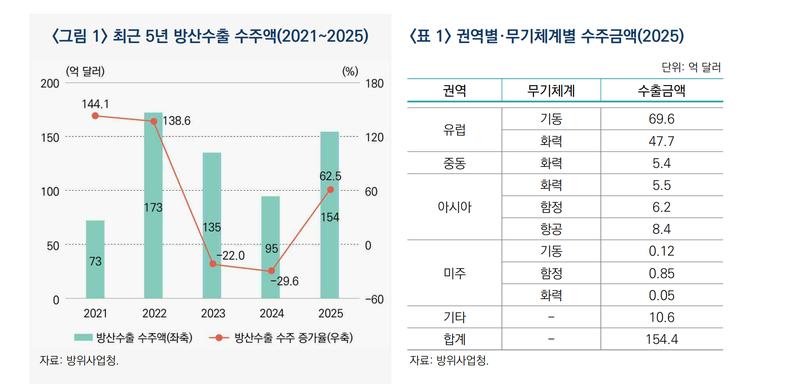
[The Financial News] Defense export orders in 2025 reached $15.44 billion, up 62.5% from a year earlier. The resulting production-inducing effect was estimated at 46.4 trillion won, while the value-added effect came to 13.7 trillion won and the employment effect to 101,000 jobs. The assessment is that the "economic ripple effects" of defense exports are now extending beyond simple export growth to domestic production and jobs.
Sharp growth driven by market diversification
According to a report released on the 21st by the Korea Institute for Industrial Economics & Trade (KIET), titled "The Economic and Industrial Significance of Defense Exports Examined Through Ripple Effects," defense exports in 2025 totaled $15.44 billion, rebounding after two consecutive years of decline. The increase was driven by larger contracts and a more diversified export market.
In particular, major orders, including large-scale contracts with Poland, helped improve the export structure in both quantitative and qualitative terms.
The impact of export growth went beyond simple expansion in scale. An analysis of economic ripple effects using the Bank of Korea (BOK)'s input-output tables showed that defense exports generate a "chain effect" that boosts production, value added, and employment at the same time. When defense exports increase by one unit, production expands by 2.085 times and value added rises by 0.616, a level comparable to or slightly higher than the manufacturing average.
The job-creation effect was also notable. Every 100 million won in defense exports was found to generate about 4.5 jobs, and the overall employment effect was estimated at more than 100,000 jobs. This appears to reflect the fact that the defense industry is not merely an assembly sector, but a high-value-added industry centered on technology and research.
In fact, the defense industry is a representative large-scale assembly sector closely linked to advanced industries such as machinery, electronics, materials, and information and communications technology (ICT). It stimulates not only upstream industries but also downstream sectors that supply parts and materials. As exports rise, the effects spread across the broader industrial ecosystem.
Another factor supporting long-term value creation is the continued demand for Maintenance, Repair, and Overhaul (MRO) after delivery.
These characteristics become even clearer when looking at the industrial linkages of defense export items. Mobility and firepower systems are connected to other transportation equipment industries, military aircraft to the aircraft industry, and naval vessels to the shipbuilding industry. Together, they create broad industrial spillover effects. This means defense exports are not limited to specific companies or sectors, but spread their impact across the entire industrial ecosystem.
The industry also received positive marks in terms of job quality. In defense, researchers account for 25% of the workforce, and regular employees make up 92%, both well above the manufacturing average. This means the sector contributes not just to job growth, but to the creation of stable, highly skilled jobs. In fact, while its shares of total manufacturing production and value added stand at just 2.0% and 1.8%, respectively, its employment share exceeds 3%, showing a relatively high contribution to jobs.
Concerns grow that ripple effects could weaken if local production expands
However, some say that expanding defense exports does not always have a positive effect on the domestic economy. That is because major importing countries are increasingly demanding technology transfers and local production, raising the possibility that the economic benefits retained at home could shrink. There are also concerns that if overseas plants are built and local sourcing of parts expands, opportunities for domestic small and mid-sized suppliers could be reduced.
In particular, because the defense sector has a wide supply chain and strong industrial linkages, any shift of production overseas could lead to a relatively larger decline in ripple effects. In other words, even if export figures rise, the "real benefits" returning to the domestic economy could actually diminish.
Against this backdrop, experts stress that future defense policy should go beyond simply expanding exports and focus on "qualitative growth."
"There is a need to enhance the economic ripple effects of defense exports by discovering high-value-added products, diversifying export markets, and strengthening the competitiveness of the defense ecosystem," said Shim Soon-hyun, a senior researcher at KIET.
[email protected] Park Ji-young Reporter