Ruling Party Rejects Scrapping Long-Term Holding Deduction, but Leaves Room to Scale Back Benefits for Long-Term Owners
- Input
- 2026-04-21 10:52:39
- Updated
- 2026-04-21 10:52:39
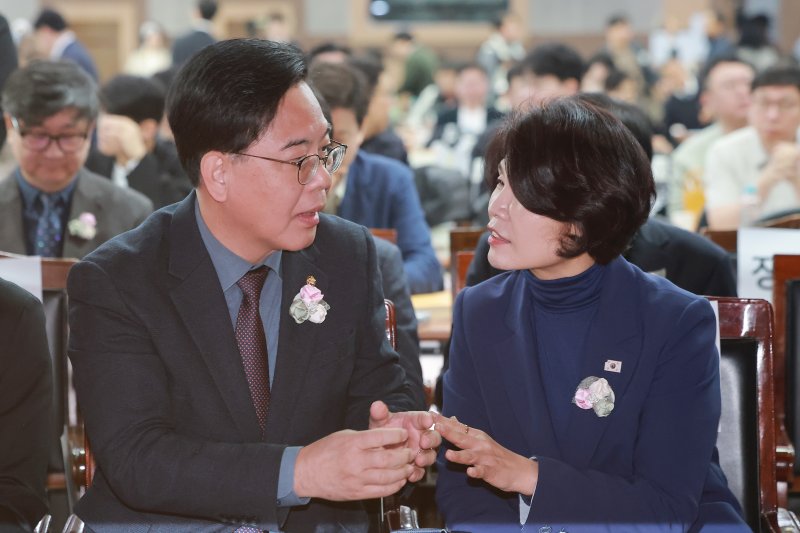
[The Financial News] The People Power Party has been mounting daily attacks over the controversy surrounding the possible abolition of the long-term holding special deduction for one-home owners' capital gains tax. In response, the Democratic Party of Korea said it had never considered the move, while leaving the door open to reforming a system that encourages long-term ownership of speculative homes.
At a floor strategy meeting on the 21st, Han Jeoung-ae, chair of the Democratic Party of Korea's policy committee, drew a line, saying, "The People Power Party is falsely claiming that we are imposing a tax bomb, but the government and the ruling party have never considered abolishing the long-term holding deduction for one-home owners."
The controversy began after Yoon Jong-o of the Progressive Party, a member of the broader ruling bloc, introduced an amendment to the Income Tax Act that included the measure. Democratic Party lawmakers Lee Gwang-hee and Lee Ju-hee also signed on as co-sponsors. The issue intensified further after President Lee Jae Myung hinted on social networking service (SNS) that the deduction could be abolished for non-resident one-home owners. That is why the People Power Party has been attacking the plan every day.
Han said, "The president's post was not about abolishing the long-term holding deduction. It raised the question of whether it is appropriate to give the same benefits as actual residents to speculators who hold expensive homes for a long time without any intention of living in them." She added, "We have repeatedly said that benefits for actual residents and unavoidable non-resident one-home owners must be maintained, and the opposition's attempt to frame this as an abolition of the deduction is malicious."
At the same time, she said the party is considering reducing benefits for long-term home ownership in line with the president's "sense of the issue." Han said, "Now is the time to sit down together and think seriously about the market freeze and widening inequality caused by encouraging long-term ownership of speculative homes." She added, "We will do our best to rationalize the system in a way that centers on actual homebuyers."
On the same day, Song Eon-seok, floor leader of the People Power Party, held a floor strategy meeting and said, "The Democratic Party has moved to calm the situation by saying there was no discussion of abolishing the deduction, but once the June local elections are over, it will use its majority to push through tax-bomb legislation at any time."
He also pointed to Korea Real Estate Board (KREB) data showing that the average apartment price in Seoul rose from 540 million won in 2012 to 1.3 billion won this year. "If someone sold an average-priced apartment after living in it as a one-home household, the current tax would be less than 1 million won, but if the deduction were abolished, it would exceed 10 million won," he said. "Using the same standard, I calculated President Lee Jae Myung's Bundang apartment. If it was bought for 360 million won in 1998 and sold for 2.9 billion won in 2025, assuming one-home occupancy throughout, the current capital gains tax would be estimated at 93 million won, but if the long-term holding deduction were abolished, it would exceed 600 million won."
The long-term holding special deduction allows one-home owners with homes valued above 1.2 billion won to deduct up to 80 percent of capital gains for tax purposes, but only if they sell after living in the home for 10 years.
[email protected] Kim Yoon-ho Reporter