"Practice Over Theory" ... Bank of Korea Under Hyun-Song Shin Takes a Practical Turn
- Input
- 2026-04-21 10:00:00
- Updated
- 2026-04-21 10:00:00
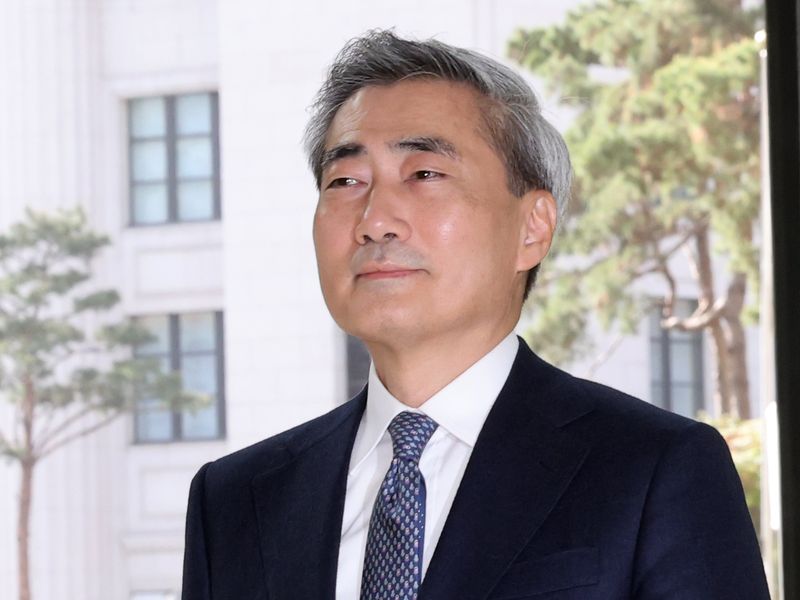
At his inauguration ceremony held on the 21st at the BOK annex in Jung-gu, Seoul, Shin said, "The evolution of central banking was not the result of following established theory, but a process in which experience led to theory." He added, "We must find answers through practice and write new theory as we go."
Shin outlined four priorities he plans to pursue during his four-year term. The first is "careful and flexible monetary policy management." He said its importance has grown even further, especially as supply shocks from the war in the Middle East have widened uncertainty over inflation and growth paths.
He also said, "To ease the complex trade-offs among policy variables, I will review policy tools and, where necessary, coordinate policy with the government." He added that he plans to strengthen two-way communication with the market and continue exploring communication methods suited to Korea's circumstances.
This appears to be connected to his answers at the confirmation hearing on the 15th. At the time, Shin mentioned the need for additional monetary policy tools beyond changes in the base rate. He said, "The BOK has a mandate for financial stability, but it has only one tool for that, which is monetary policy," and added that it would be desirable to discuss improvements with relevant institutions.
Shin next said that a "new perspective on financial stability" is needed. He assessed that financial markets are rapidly erasing boundaries between banks and non-banks, as well as between domestic and overseas sectors, while becoming more closely linked to asset markets and exerting greater spillover effects on the real economy.
Accordingly, he said, "I will strengthen early warning functions by making more active use of market price indicators alongside existing soundness indicators." He added that it is necessary to improve access to information on the non-bank sector and expand analysis to off-balance-sheet transactions and non-traditional financial products.
Shin also identified the "internationalization of the Korean won" as an important task. At his confirmation hearing, he said, "Through the internationalization of the Korean won, we need to increase liquidity and establish related systems within a macroprudential framework." He added that one reason for building an offshore settlement system is to manage the won's standing across the financial system and exchange rates.
This time, he said, "Together with the government, we will push to open the foreign exchange market 24 hours a day and build an offshore won settlement system to improve the accessibility and stability of foreign exchange transactions in line with international standards." He added that this would promote capital and real transactions based on the won, raise the currency's international standing, and contribute to the stable development of the foreign exchange market.
Shin also said he would expand the use of central bank digital currency (CBDC) and deposit tokens through the second phase of Project Han-gang, which the BOK is currently pursuing. He said international cooperation, including Project Agora, which he led at the Bank for International Settlements (BIS), would also help raise the won's standing in the digital payments environment. He did not separately mention a Korean won stablecoin.
Finally, Shin signaled that he would carry forward and implement "economic structural reform," a priority emphasized by former Governor Rhee Chang-yong. He said that as the economic structure changes, a widening gap between economic reality and people's perceptions can even affect the transmission channels of monetary policy, adding that structural factors are not separate from monetary policy but an important part of it.
Shin also previewed changes in how the BOK will operate in order to carry out these tasks. First, he said he would create an environment in which each employee can fully develop their capabilities. He said, "I will work to improve organizational culture and internal management so that growth opportunities are broadly provided across research, policy, operations and administration, and so that fair treatment is supported."
He also hinted at an integrated restructuring of the organization. Shin said, "I hope the various divisions within the BOK will break down barriers and move organically." He explained that it is important to have deep expertise in one's own field while also broadening understanding of other areas to build a comprehensive perspective.
Shin also stressed the need to expand digital technologies such as artificial intelligence within the organization. He said, "Without changing the way we work itself, it is difficult to expect meaningful productivity gains." He added that he would look for room to improve the overall operation of the organization, including data systems, workforce management and information sharing.
Lastly, Shin cited the former governor's "K-dot plot" as an example and pledged to actively participate in shaping domestic and international discourse so that the research and policy experience accumulated by the BOK can lead to meaningful contributions in global discussions, including those at the BIS and the International Monetary Fund (IMF).
\r\n
taeil0808@fnnews.com Kim Tae-il Reporter