Boy Laborer and Chaiwala... Lee and Modi Hold Heated Talks Beyond Scheduled Summit Time
- Input
- 2026-04-21 06:38:24
- Updated
- 2026-04-21 06:38:24
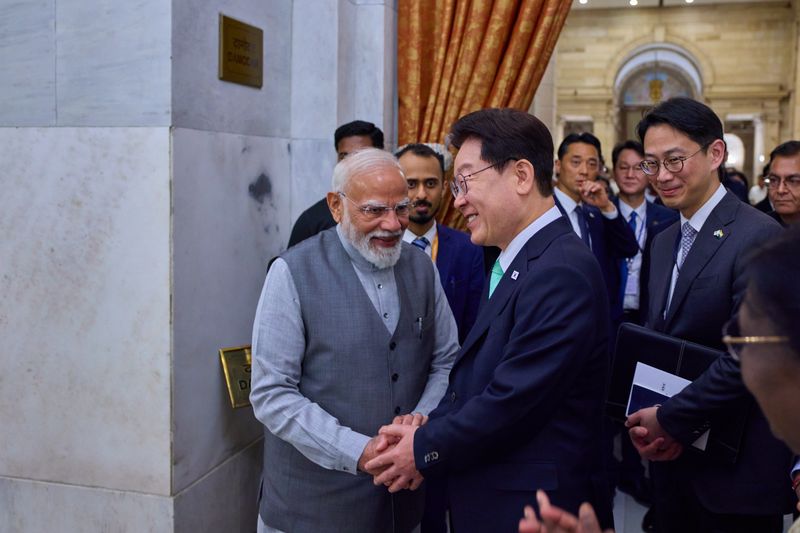
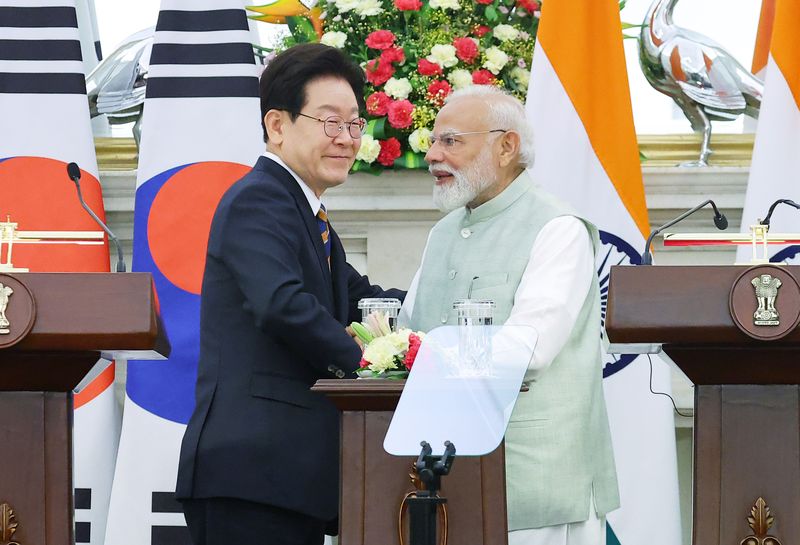
Wi Sung-lac, head of the Office of the National Security Adviser, said in a written briefing that "what stood out throughout this visit to India was the very deep personal closeness the two leaders showed, like friends meeting again after a long time." He added, "Prime Minister Modi said he warmly remembers his first meeting with President Lee in Canada last year and has high expectations for this summit. President Lee also said he felt delighted, as if meeting an old friend, when he met the former child laborer and chaiwala, and he expressed a deep bond with Prime Minister Modi."
In particular, the two leaders reportedly kept up their close conversation well past the scheduled time.
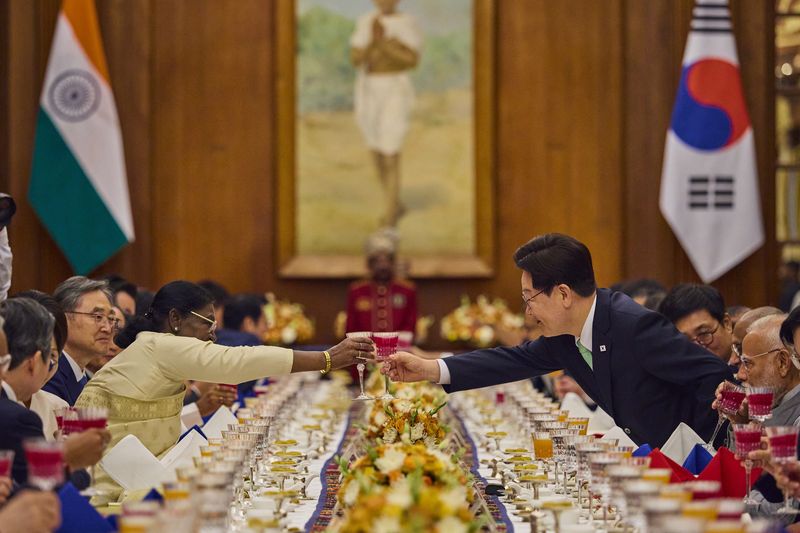
Wi said, "Summits usually begin with a small-group meeting followed by an expanded session. The small-group talks, which were initially expected to last about 40 minutes, went on for more than an hour as the two leaders held an intense conversation. Their protocol teams even had to alert both sides to the delay in the schedule that followed." He added, "The meeting with the president and the state dinner also continued well beyond the planned time, alongside warm and substantive talks between the two sides. The dinner was originally scheduled to end at 8:30 p.m., but it took nearly an hour longer, and the official schedule for the day was not completed until 9:40 p.m."
At the summit, the two leaders agreed that although bilateral relations have advanced significantly over the past 10 years since being elevated to a Special Strategic Partnership in 2015, they are still not fully satisfactory compared with the potential for cooperation. They also agreed to develop the relationship to a completely new level through this meeting. In addition, they shared the view that it is important for the two countries to achieve progress through broad cooperation based on democratic values.
They also strongly agreed that South Korea and India are the best partners for realizing their respective national development visions, "National Leap" and "Viksit Bharat 2047." As uncertainty deepens due to the Middle East war and other factors, they decided to work even more closely together to promote mutual growth and innovation and to overcome difficult global economic conditions.
During the small-group meeting, Prime Minister Modi said that Rabindranath Tagore, India's Nobel Prize-winning poet, predicted more than 100 years ago that Korea would become a light of the East, and that prophecy has now become reality and led to the light revolution.
Lee said that, given India's population and Gross Domestic Product (GDP), the number of Korean nationals in the country, at 12,000, and the number of Korean companies operating there, at around 670, show that Korea–India relations have remained stagnant. He added that the two sides should use this summit to pursue a much higher level of cooperation in people-to-people exchanges, economic cooperation, and security cooperation.
He also explained in detail to Prime Minister Modi the difficulties faced by Korean companies operating in India and small and medium-sized firms considering future investment, as well as the issues raised at a meeting with the Korean diaspora the previous day, and asked for improvements. Modi expressed his appreciation for the explanation and promised on the spot that he would listen closely to the concerns of Korean companies and seek ways to resolve the problems.
At the expanded session, the two sides held in-depth discussions on ways to develop strategic economic cooperation in new strategic sectors such as shipbuilding, finance, AI, and the defense industry. Wi also said they exchanged views on how South Korea and India can contribute to international peace and stability amid the Middle East war, and how they can cooperate as major importers of key energy and raw materials, including Naphtha.
Wi said, "This state visit to India, the first in eight years, marked the full-scale launch of our Global South diplomacy. It also created new momentum for cooperation with India, a country of 1.4 billion people that is growing rapidly, and expanded the horizon of bilateral cooperation into future-oriented and strategic fields."
[email protected] Choi Jong-geun Reporter