[Editorial] The More Educated Young People Become, the More of Them End Up Taking a Break from Work
- Input
- 2026-04-20 19:10:47
- Updated
- 2026-04-20 19:10:47
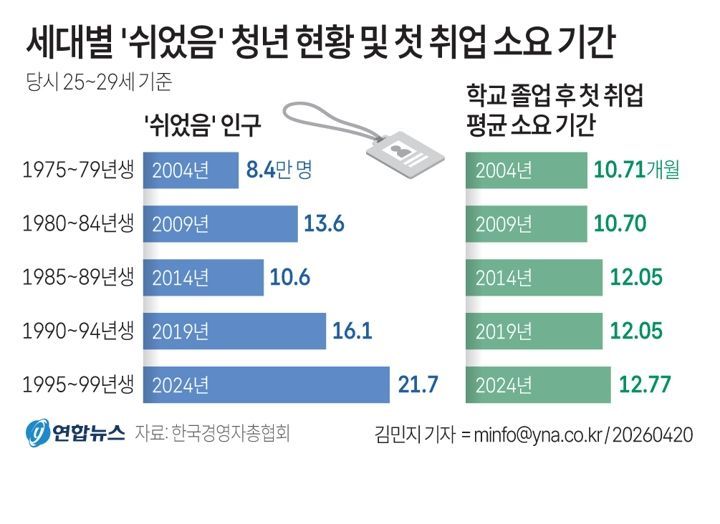
According to KEF, 170,000 of the 210,000 young people in this category, or 80 percent, were college graduates or above. That number rose from 153,000 in 2023 to more than 170,000 the following year, and last year it came close to 180,000. By contrast, the number of young people with a high school diploma or less who were out of work, school, or job search has shown little change in recent years. The heavy social cost of extending educational credentials, and the resulting educational inflation, are serious problems for our society. A comprehensive youth policy that covers the whole picture is needed.
The time it takes to land a first job is also getting longer. In addition, the share of young people among new hires classified as having less than one year of tenure has fallen by 8.4 percentage points over the past 20 years. This reflects a reality in which employers are reluctant to hire inexperienced young workers.
The employment difficulties facing highly educated young college graduates are likely to become even more serious. As artificial intelligence (AI) spreads further across workplaces, youth employment will come under greater threat. Statistics already show that AI is replacing new workers in fields such as accounting, law, finance, consulting, and information technology (IT). AI is also blocking the career path that once allowed newcomers to learn the job and move on to better positions. The market may end up with only a small number of top-tier professionals, mid-career workers, and AI. Most young people could be left either continuing to take time off or cycling through low-skill, low-wage jobs.
When warning signs appear, the response must be more aggressive and immediate. Above all, the mismatch between labor supply and demand, as well as excessive wage gaps, must be addressed first. Young people sink into a swamp of helplessness, saying they have nowhere to go, while small and medium-sized firms complain of labor shortages. That disconnect is a chronic problem. Industry and academia need to join forces and come up with practical, workplace-tailored education solutions.
Excessive wage increases at some companies could also become an obstacle to new hiring at mid-sized firms. It is only fair for workers to share in corporate profits, but bonuses and pay hikes at a level that creates social resentment end up worsening labor shortages at smaller companies. Last year, hourly wages for young regular workers at large companies were 43 percent higher than those of young non-regular workers. Large-company unions should also refrain from excessive demands in the spirit of mutual growth.
President Lee Jae Myung recently said that youth policy should not be treated as a side issue, and he pointed to the need for a dedicated organization. It is late, but that is the right direction. Youth employment difficulties must be solved with bold measures that address supply-demand mismatches, educational inflation, employment flexibility, and a rational labor-management culture. A dedicated department must take the lead.