[Editorial] In an Era of Multipolarity, Make India a Gateway to the Global South
- Input
- 2026-04-20 19:10:45
- Updated
- 2026-04-20 19:10:45
A foreign and trade strategy that depends on a single country can quickly run into a dead end in a crisis. That is why diversifying trade and cooperation is now essential. At the center of that effort, the strategic value of the Global South has never been higher. In both economic and diplomatic terms, India is a partner with enormous potential for Korea.
From the standpoint of both the economy and security, it is advantageous to secure as many options as possible. If one of those options also offers strong growth in trade, that is even better. India is the top strategic base for a Global South strategy and the ideal country for it. With a population of 1.4 billion and the world's fourth-largest nominal GDP, it is also growing at an annual rate in the 7 percent range. As companies around the world have called for a move away from China, many have chosen India as the alternative. India is the main beneficiary of the so-called China Plus One strategy.
Korea's influence in the Indian market remains below expectations, despite the flood of interest from foreign companies. Korea's share in India's final consumer goods import market fell from 1.0 percent in 2018 to 0.7 percent in 2024. Exports have increased, but not fast enough to keep pace with the market's growth. In other words, while India's strategic value has risen, Korea's investment and attention have not kept up.
Now is the time to look at India again and expand Korea's influence there. China's share in the Indian market has been on the decline. It fell from 27.1 percent in 2018 to 18.5 percent in 2024. As Korea's national image improves, this is a golden chance to raise market share in India by leveraging high-quality products and strong brand power. Another point to keep in mind is that the European Union (EU)-India Free Trade Agreement (FTA) is expected to take effect in 2027. If Korea does not move quickly to enter the Indian market now, European brands could seize the advantage first.
Trade between Korea and India extends far beyond consumer goods. Korea's strengths in memory semiconductor design and manufacturing could combine with India's vast information technology (IT) workforce and domestic market to create strong synergies. There is also broad room for cooperation in Smart Manufacturing, EVs, batteries, shipbuilding, and shipping, all of which offer substantial trade potential.
Cooperation is also widely possible in economic security, a field that has recently emerged as a major global issue. Both sides are expected to work together on critical minerals, which China dominates, as well as on energy and defense, areas that have drawn even greater attention because of the situation in the Middle East. Attractive as the market is, India also has high barriers to entry. Its complex regulatory environment is the first structural obstacle Korean companies encounter.
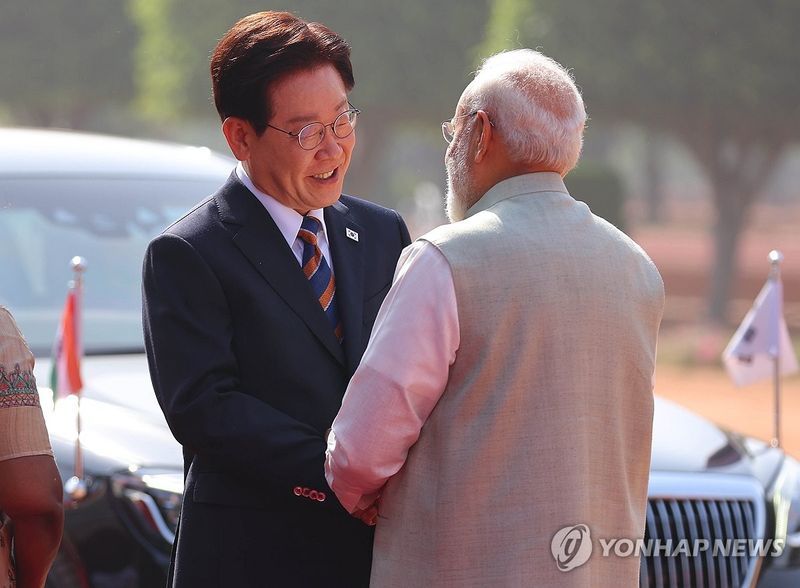
In that sense, the Korea-India summit is expected to serve as a momentum for opening up future trade between the two countries. In an era of multipolarity, Korea must expand exchanges beyond any single major power and engage more broadly with the world. Using India as a bridge, it should build a dense cooperation network across the Global South, extending to ASEAN, the Middle East, and Africa. We hope this summit will help Lee Jae Myung's government fully realize its pragmatic diplomacy centered on national interest.