Minister Kim Sung-hwan: "We will support the localization of solar panels and inverters... Korean-made products will be prioritized in subsidy programs"
- Input
- 2026-04-21 11:00:00
- Updated
- 2026-04-21 11:00:00
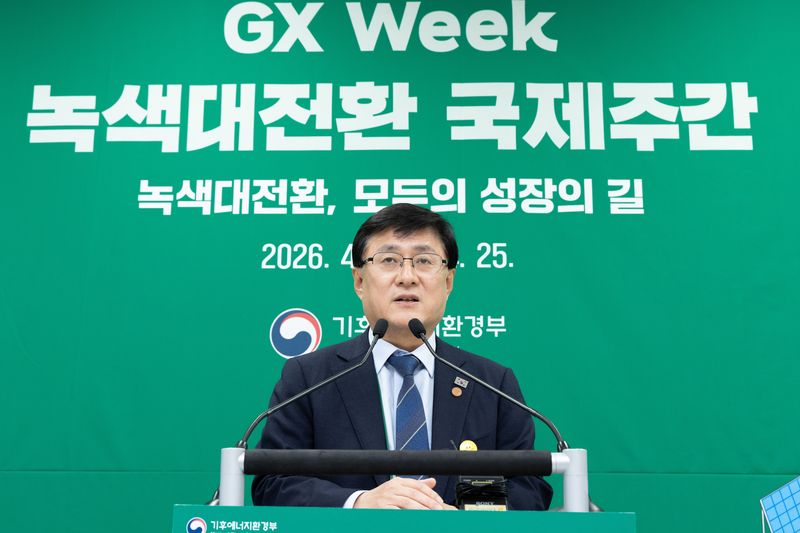
[Financial News] Kim Sung-hwan, Minister of the Ministry of Climate, Energy and Environment, reaffirmed the policy of requiring domestically produced inverters to help nurture the local solar market, while making clear that the rule will be applied first only to subsidy programs funded by taxpayers.
At the press briefing for Green Transformation International Week (GX Week) held on the 20th at the Yeosu Expo Site in Yeosu, South Jeolla Province, Kim outlined measures to support the domestic solar industry.
He said China controls more than 90% of the global solar market, and the same is true for inverters. "If Korea also collapses, the entire world will become a single market, so this is a matter of life and death," he stressed. He added, "We will support the inverter industry so it can build technological strength and price competitiveness," and said, "As large-scale solar-related orders are expected soon, we will also take good care of this industry."
He also addressed waste-treatment issues raised after the official announcement of a 100 GW renewable energy target by 2030. Kim explained, "Used solar panels are collected free of charge through six hubs nationwide and then recycled, and technology to separate the cell membranes more precisely is currently under Research and Development (R&D)."
On the recycling status of wind turbine blades made from special carbon fiber, however, he said, "It has not yet been sufficiently checked," adding, "We will review it so that it can fall within the recycling category and report back separately."
As local government leaders from both ruling and opposition parties race to mention attracting SMRs ahead of the election, Kim took a cautious stance. He said, "SMR projects are undergoing meaningful experiments around the world, but they are not yet at the commercialization stage," and added, "Korean SMRs are aiming for their first power generation in 2035, so we should determine whether they succeed before deciding whether to expand them to other regions." He also noted the limitation that Korean SMRs can only be sited near water because they use cooling water.
Amid concerns over unstable naphtha supplies caused by the war in the Middle East, he also said the government will strengthen its plastic reduction policy. Kim stated, "Since the second draft public hearing in December last year, we have been gathering opinions, and as the President emphasized plastic reduction at the State Council of South Korea, we plan to report it to the council soon in a manner similar to the Energy Transition Report." He also suggested that the final plan will include stronger measures than the original draft.
In response to criticism that financing is insufficient for the Green Transformation goals, he said, "The Ministry of Climate, Energy and Environment, the Ministry of Economy and Finance, and the private sector, centered on the Korea Chamber of Commerce and Industry (KCCI), are detailing the division of roles between the government and the private sector, as well as the required funding scale," adding, "We should be able to announce the overall outline of KGX, including Green Bonds, around June."
Regarding the installation of a 500 kV high-voltage grid at Dongseoul Converter Station, he said, "We have held multiple rounds of talks with KEPCO and residents in opposition, and internally we believe it is realistically difficult to find another alternative." He added that the ministry is internally reviewing ways to improve public acceptance, taking into account residents' psychological and physical concerns caused by nearby apartment construction, and said consultations with residents will resume once the review is completed.
leeyb@fnnews.com Lee Yoo-beom Reporter