"I Forgot to Click 'Save' and Could End Up Disciplined"... Lower-Ranking Police Officers Tremble Over Asset Declarations
- Input
- 2026-04-21 11:16:51
- Updated
- 2026-04-21 11:16:51
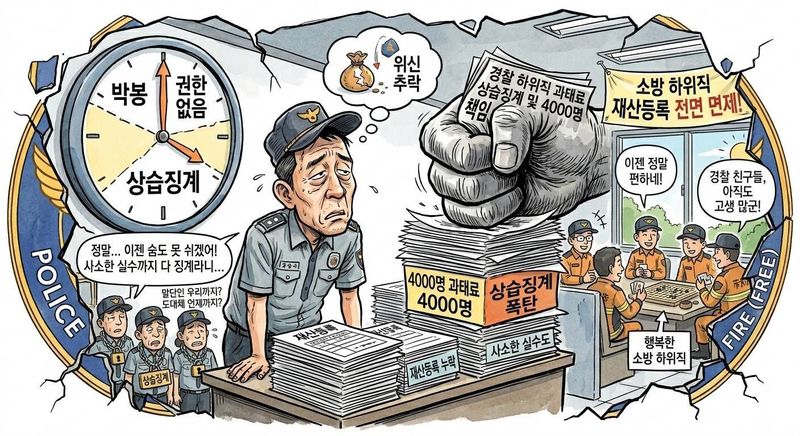
[The Financial News] Complaints are mounting within the police organization over who should be required to file asset declarations. Unlike other public-sector organizations such as the fire service, police officers from the rank of sergeant and above, which accounts for about 70% of the force, must file declarations. Critics say the scope is too broad, and some inside the force argue that even minor omissions can land officers on a list for legal action, amounting to a modern-day witch hunt.
According to a report by The Financial News on the 21st, thousands of police officers nationwide were reportedly subject to legal action last year over omissions in public officials' asset declarations. Such measures are not minor, as they can lead to fines and disciplinary action. The number of cases is said to have risen to more than 300 in 2024, compared with just three in 2023, with tighter inspections cited as the main reason for the surge.
For several years, police cases that met the criteria for punishment were often closed administratively or resulted only in corrective orders. But this year, asset review operations were added to performance evaluation indicators. That means staff in audit departments are rewarded more heavily when they uncover colleagues' omissions in asset declarations. As a result, some are criticizing the system for encouraging internal division.
The scope of those required to file asset declarations in the police is set out in the Enforcement Decree of the Public Service Ethics Act. When the law was enacted in 1981, it applied only to police officers at the rank of superintendent and above, equivalent to Grade 4 in the general civil service. But after the decree was revised in 1994, it was expanded to include working-level ranks such as senior inspector, inspector, and sergeant. Of the country's 130,000 police officers, only about 800, or 0.67%, are at the rank of superintendent or above, while more than 96,000, or 73.8%, are sergeants or above.
The problem is that such strict standards are being applied only to police officers. Under the decree, unlike police officers, firefighters at the working-level ranks of fire lieutenant and fire captain can be exempted from filing asset declarations if they receive approval from the Public Service Ethics Committee. General civil servants also face a lighter burden, as the requirement starts at Grade 4 and above.
As a result, frustration is boiling over inside the police force. Many posts on the internal bulletin board known as the Field Vitality Board called for protection from punishment over omissions in asset declarations. One officer wrote, "I temporarily owned two apartments because of a move this year, but I accidentally declared only one of them," adding, "I may be facing a fine of nearly 20 million won over this issue, and I have been breaking into a sweat and feeling my heart race even in my daily life." Another officer said, "I completed the asset registration, but at the end I accidentally failed to press the 'Save' button, and I was told the case is scheduled to be submitted to the Public Service Ethics Committee," asking for advice.
The Workplace Council, which functions like a labor union within the police, has called for revisions to the current law. Jung Hak-seop, head of the Workplace Council at Busan Bukbu Police Station, said, "The scope of police asset declarations has not changed even though the decree has been revised 91 times," adding, "Since officers can be promoted by seniority up to the rank of senior inspector, asset registration should at least begin at the rank of superintendent. We need to prevent lower-ranking officers with smaller assets from wasting time and causing administrative inefficiency."
In response, the Korean National Police Agency (KNPA) said, "A constitutional complaint over the ethical obligations of officers at the rank of sergeant was dismissed last year, so an immediate legal revision is not easy," adding, "We will actively reflect the views of frontline officers and consult with relevant agencies."
[email protected] Baek Chang-hoon Reporter