Regional Banks' Corporate Lending Grows in Size, but Manufacturing Share Slips
- Input
- 2026-05-03 06:00:00
- Updated
- 2026-05-03 06:00:00
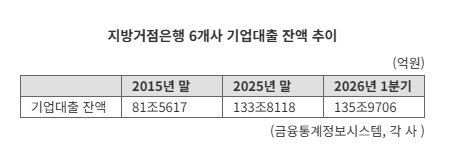
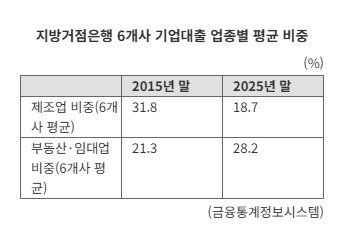
According to the Financial Statistics Information System on the 3rd, a comparison of the average industry share of corporate loans over the past 10 years at six regional banks — iM Bank, Busan Bank, BNK Kyongnam Bank, Gwangju Bank, THE JEONBUK BANK LTD., and Jeju Bank — showed that manufacturing loan share fell by 13.2 percentage points, while the share for real estate and leasing rose by 6.8 percentage points.
At iM Bank, corporate loan balances rose from 21.8265 trillion won in 2015 to 34.6462 trillion won at the end of last year and 35.8792 trillion won at the end of the first quarter this year, up 64%. Over the same 10 years, the share of loans to manufacturing companies fell from 46% to 29%, while the share for real estate and leasing climbed from 17% to 22%.
Busan Bank and BNK Kyongnam Bank showed the same trend. As of the first quarter this year, corporate loan balances at Busan Bank and BNK Kyongnam Bank stood at 40.04 trillion won and 29.7479 trillion won, respectively, marking a larger scale than 10 years ago. But the share of manufacturing fell by about 15 percentage points and 22 percentage points, while real estate and leasing rose by 8 percentage points and 5 percentage points.
The concentration in real estate and leasing was even more pronounced at Gwangju Bank and THE JEONBUK BANK LTD. Gwangju Bank's manufacturing loan share fell by 16 percentage points over the past 10 years, while its real estate and leasing share rose by 17 percentage points. At THE JEONBUK BANK LTD., the manufacturing share dropped by 8 percentage points, but real estate and leasing increased by 7 percentage points. Jeju Bank's manufacturing loan share remains low at 7% to 8%. Its real estate and leasing share is 18%, more than twice that of manufacturing.
The overall size of corporate lending at regional banks has been steadily increasing. The combined corporate loan balance of the six banks rose from 81.5617 trillion won in 2015 to 133.8118 trillion won at the end of last year and 135.9706 trillion won as of the first quarter this year. Even though corporate lending expanded by about 66.7%, the money shifted not to manufacturing but to real estate and leasing.
Regional banks are financial institutions closely tied to local economies. They serve as a source of funding for small and medium-sized enterprises and manufacturers based in the region. As the government emphasizes productive finance to channel funds into strategic industries, some say regional banks' lending portfolios also need to be reviewed.
Industry officials said the trend reflects slowing manufacturing conditions and growing concerns over asset quality. Manufacturing loans can become riskier as business conditions fluctuate, while real estate and leasing are more attractive to banks because collateral values are clearer.
Competition with commercial banks for loan clients is also seen as a factor making it harder for regional banks to expand productive finance. A regional bank official said, "Since productive finance began, commercial banks have been taking over loans to strong companies located in the regions." The official added, "This leaves regional banks to shoulder small and medium-sized borrowers with higher credit risk or borrowers more sensitive to local economic swings." The official also said, "We agree that productive finance needs to expand, but regional banks already have a high share of corporate lending, so we cannot ignore asset-quality concerns."
chord@fnnews.com Lee Hyun-jung Reporter