Anyang Correctional Institution Nears 140% Capacity as Justice Minister Questions Whether Rehabilitation Is Possible
- Input
- 2026-04-19 19:11:05
- Updated
- 2026-04-19 19:11:05
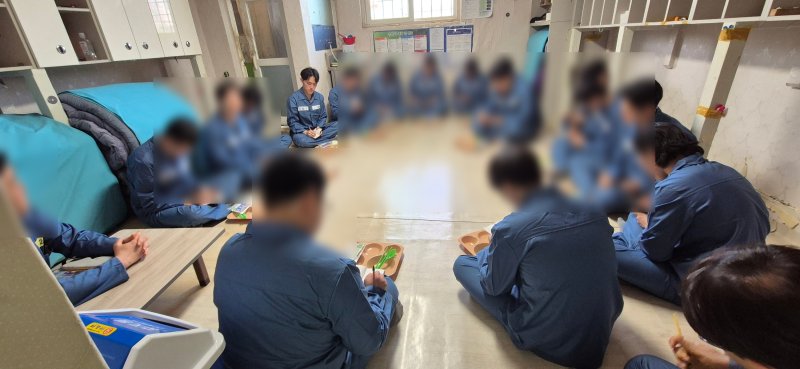
The experience began with the intake process. Participants handed over their mobile phones and belongings, underwent a physical checkup, and were issued prison uniforms. Their names were replaced with inmate numbers, and only the bare minimum of personal items was allowed to remain. In an instant, the process changed them from members of society into inmates.
As soon as we entered the prison building, a damp smell hit us first. Wiring and hot-water pipes were exposed on the ceiling, and wallpaper was peeling in many places. Officials said the damage had been repeatedly caused by inmates with mental illnesses. Anyang Correctional Institution is a facility that was moved to its current location in 1963 and is now more than 60 years old. Of its 89 buildings, 34 have been classified as Grade C, meaning they require repairs and reinforcement, underscoring the severity of the deterioration.
In a room of just 24.8 square meters, 16 reporters and two correctional officers were together. In reality, 15 to 16 inmates live in that space on average. Each person had barely enough room to spread out a blanket, and they kept bumping into one another while eating or moving around. The layout makes it impossible to maintain distance between inmates. The facility is designed for 1,700 people, but as of the 17th, it held 2,284, pushing the occupancy rate to 134.4%. The restroom was also inside the cell. The seat in front of the toilet belonged to the youngest inmate, and after meals, dishes had to be washed there.
The burden of overcrowding also falls on correctional officers. At night, 33 staff members from the security division manage more than 2,000 inmates. During the day, the situation is equally strained, with each officer responsible for at least 50 to 100 inmates. Jeong Seong-ho, the Minister of Justice, who visited the site, pointed out that "it is difficult for rehabilitation and correction to be properly carried out under such severe overcrowding."
Overcrowding is not a problem limited to one facility. The average occupancy rate at correctional facilities nationwide stands at 126.1%, while women’s facilities reach 137%. Friction in cramped spaces turns into conflict. The number of disciplinary cases involving inmates jumped 60.8% from 21,640 in 2021 to 34,510 last year. In other words, overcrowding is hardening into a cycle of conflict and punishment.
scottchoi15@fnnews.com Choi Eun-sol