KOSPI Rebounds Strongly After Volatility, Posts World's Highest Gain This Month
- Input
- 2026-04-19 18:26:51
- Updated
- 2026-04-19 18:26:51
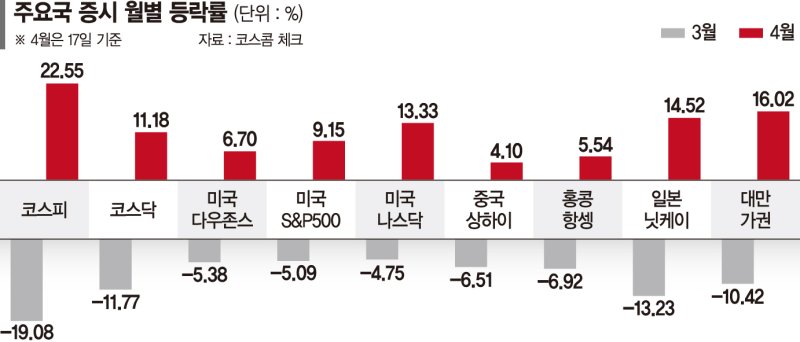
According to Koscom Corporation's Check data on the 19th, the KOSPI Composite Index rose 22.55% from the start of the month through the 17th, the only major global market to post a gain in the 20% range.
The Taiwan Capitalization Weighted Stock Index (TAIEX) ranked second with a 16.02% increase, followed by the Nikkei 225 at 14.52%, the NASDAQ Composite Index (IXIC) at 13.33%, and KOSDAQ at 11.18%, all posting gains in the 10% range. They were followed by the Standard & Poor's 500 Index (S&P 500) at 9.15%, the Dow Jones Industrial Average (DJIA) at 6.70%, the Hang Seng Index at 5.54%, and the Shanghai Composite Index at 4.10%.
So far this year, the KOSPI Composite Index had risen 48.17% through February, extending its global lead after a 75.63% gain last year. But after surging so sharply, it became highly volatile following the war between the United States and Israel and Iran.
Last month, the KOSPI Composite Index plunged 19.08%, making it the most sensitive to the Middle East crisis. That decline was also steep compared with lower-ranked markets such as the Nikkei 225 (-13.23%), KOSDAQ (-11.77%), and TAIEX (-10.42%). The Hang Seng Index (-6.92%), Shanghai Composite Index (-6.51%), DJIA (-5.38%), S&P 500 (-5.09%), and NASDAQ Composite Index (IXIC) (-4.75%) held up relatively well.
The rapid recovery in the domestic market is being attributed to the appeal of valuations after external shocks drove the index down sharply. Expectations for record earnings, led by Samsung Electronics and SK hynix, have also strengthened that view.
Operating profit for KOSPI-listed companies this year is projected to reach the 700 trillion won to 800 trillion won range, up 160% to 180% from a year earlier. Even so, the KOSPI's forward price-earnings ratio (PER) remains below 8 times. In the securities industry, a forward PER below 8 times is generally seen as a period of extreme undervaluation.
Lee Kyung-min, a researcher at Daishin Securities, said, "If a forward PER of 8 times is applied, the index would be at the 6,600 level, which means the gap between earnings and fundamentals has widened significantly." He added, "Unless the economy deteriorates immediately or earnings forecasts are sharply revised downward, an overweight strategy based on valuation normalization remains valid."
He also said, "If SK hynix's results also beat expectations after Samsung Electronics, the KOSPI's valuation appeal and expectations for stronger momentum will be amplified." He added, "If results fall short, short-term volatility could increase, but the direction of earnings improvement is clear."
In particular, Samsung Electronics and SK hynix, which are expected to rank second and fourth globally in operating profit this year, are seen as being in an excessively undervalued range.
Kim Dong-won, head of research at KB Securities, said, "Although the combined operating profit of Samsung Electronics and SK hynix this year is expected to be five times higher than TSMC's, TSMC's market capitalization exceeds the combined market value of the two companies, which suggests they are trading at an excessive discount." He added, "Given the pace and scale of earnings improvement, a combined valuation of more than 330 trillion won, including 200 trillion won for Samsung Electronics and 130 trillion won for SK hynix, appears appropriate."
[email protected] Seo Min-ji Reporter