Why Did a Kyoto Elementary School Rumor About a "Chinese Stepfather" Turn Into News? [Japan Inside]
- Input
- 2026-04-19 10:16:26
- Updated
- 2026-04-19 10:16:26
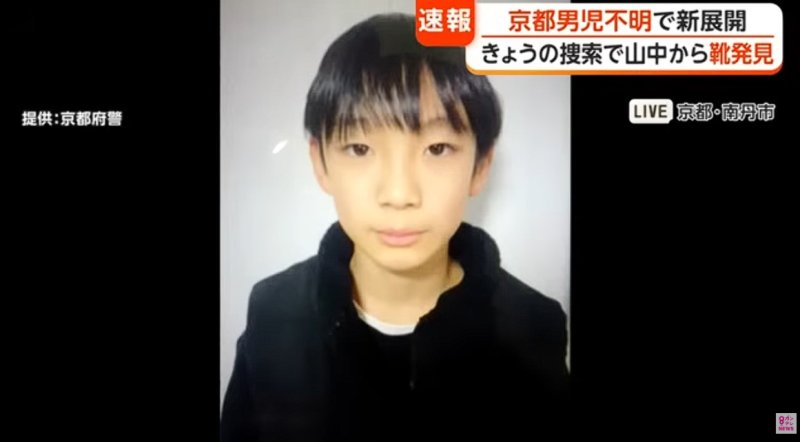
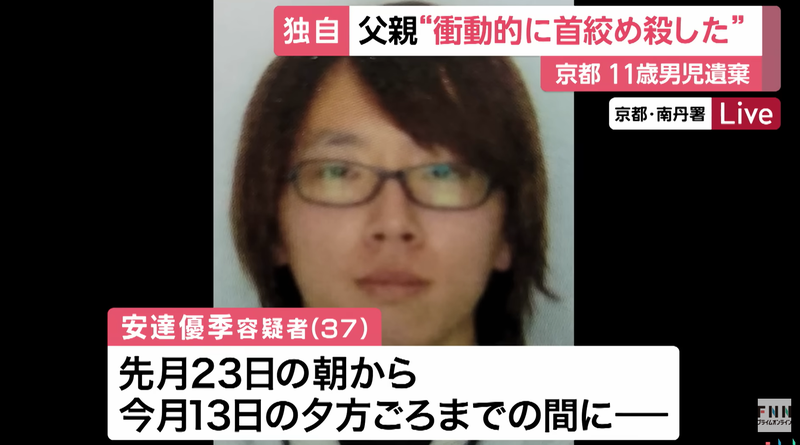
[The Financial News, Tokyo = Correspondent Seo Hye-jin] The disappearance of a Kyoto elementary school student, which shook Japan for the past three weeks, was ultimately revealed to be the crime of his stepfather. Yuki Adachi, 11, a student at Sonobe Municipal Elementary School in Nantan City, Kyoto Prefecture, was found dead three weeks after he vanished on his way to school on the 23rd of last month, and his stepfather, Yuki Adachi, 37, was arrested on the 16th on suspicion of abandoning a body. The case shocked Japanese society because it involved a family member, but it also drew controversy as false information about the stepfather's nationality spread between Japan and Taiwan. Unverified claims posted on social media gained the appearance of a news report through overseas broadcasting, then flowed back into Japan, where they appeared more credible.■ Missing on the way to school, elementary school student found dead; stepfather admits to the crimeAccording to Kyoto Prefectural Police, the child who went missing on the 23rd of last month was found dead on the 13th in a mountain area in Nantan City, Kyoto Prefecture. On the 16th, the child's stepfather was arrested on suspicion of abandoning the body. Investigators said the suspect admitted to abandoning the body and that statements related to the killing had also been obtained. Police are continuing their investigation, focusing on the motive and circumstances of the crime.
According to the weekly magazine Shukan Bunshun, the suspect graduated from a public high school in Kyoto, then joined a factory specializing in electronic parts and was later promoted to head of the quality control department. His work performance was reportedly not poor.
His private life, however, appears to have been complicated. Testimony suggests that he married a woman 16 years older than him, who worked at the same company, had children with her, then became involved with the victim's mother, who was also a colleague, before divorcing and remarrying.
His movements just before the incident also raise questions. Four days before the child disappeared, on the 19th of last month, the victim's mother told coworkers that she was taking leave because she was going on a "honeymoon in Taiwan."
Although the suspect had not filed for leave in advance, he suddenly called in sick that morning, saying he had "norovirus." On the day the child went missing, the 23rd of last month, he also called the company and said he would take time off because there was "a family matter." What happened at the time of that statement remains unconfirmed.
Items found before and after the incident also left questions unanswered. A school bag and shoes were discovered in a place that would have been difficult for an elementary school student to reach alone, raising the possibility that someone had intentionally moved them. Investigators are reconstructing the case as a whole, including signs that a vehicle may have been used.
Those claims were not confirmed in Japanese media reports. Despite the unclear source, some accounts posted them as fact, and the content spread quickly, drawing millions of views.
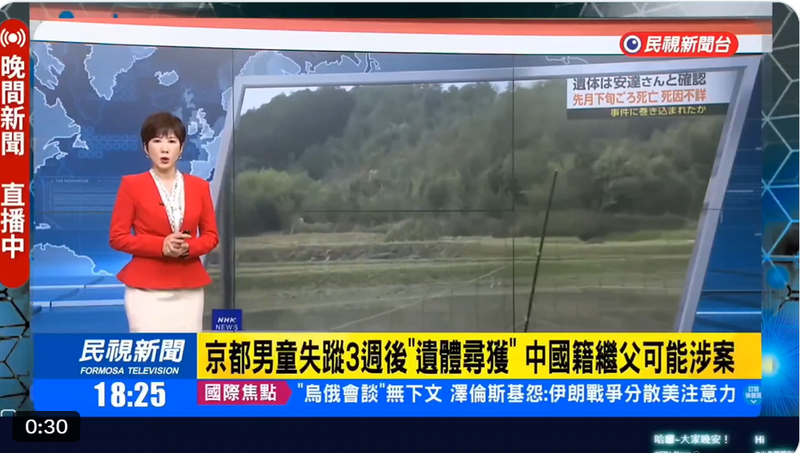
The problem was that the information was amplified after reaching overseas media. On the 15th, before the suspect was arrested, Taiwan's Formosa Television (FTV) reported, based on content circulating on Japanese social media, that "the Japanese weekly Shukan Bunshun raised the possibility that the stepfather was Chinese." The screen even included a caption reading, "Possibility of involvement by a Chinese-national stepfather." However, no such content appeared in the actual Shukan Bunshun article.
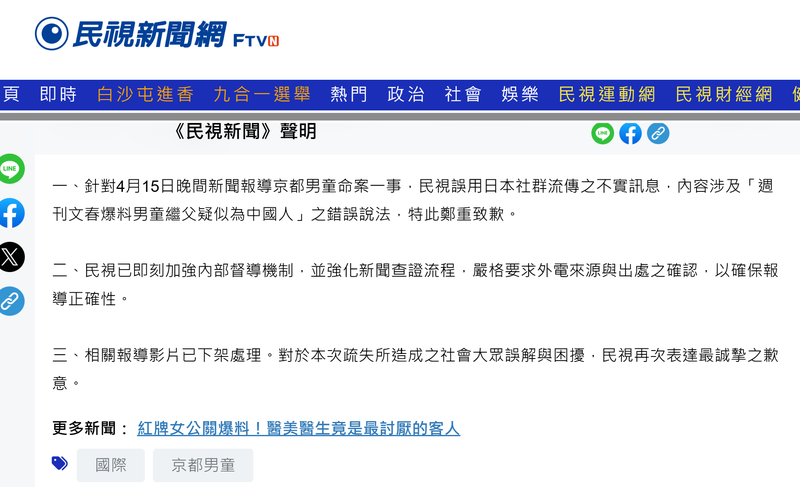
Two days later, on the 17th, FTV issued an official statement saying it had "used false information spread on Japanese social media," acknowledged the error, and apologized. It also said the related video had been removed. By then, however, the broadcast had already been translated into Japanese and spread again on Japanese social media. A cycle had formed in which a rumor created in Japan was repackaged as "foreign media coverage" through a Taiwanese broadcaster and then flowed back into Japan.
One post on X shared the broadcast and wrote, "Taiwanese media are correctly reporting that there is a possibility the stepfather, a Chinese national, was involved. Why is Japan hiding this important fact?" The post was shared more than 20,000 times and received over 88,000 likes.
Kyoto Prefectural Police, however, officially denied the rumor that same day, saying, "There is no fact that the suspect is a foreigner."
A similar pattern has appeared before. During the 2016 Sagamihara stabbings, rumors spread on social media that the attacker was a foreign resident in Japan, but the case was later revealed to have been carried out by a former employee with Japanese nationality acting alone.
In the 2019 Kyoto Animation arson attack, posts claiming it was the work of a foreigner also spread, but that case too was a lone attack by a Japanese national.
During the COVID-19 pandemic, generalized claims that foreigners were the main source of infection repeatedly circulated, and in debates over the release of treated water from Fukushima Prefecture, conspiracy theories targeting specific countries spread through social media.
All of these cases share the same pattern: uncertainty immediately after an incident, a definitive but unfounded hypothesis, the appearance of fact through repeated sharing, and renewed spread through external channels.
Experts say this phenomenon exposes a structural problem in the information environment. On social media, where speed and sensationalism are prioritized over source verification, information that singles out a particular group or nationality spreads easily, while corrections come much later.
The current investigation is focused on determining the suspect's motive and the exact circumstances of the crime, but posts are still appearing on social media claiming that "the stepfather was originally Chinese and changed his nationality." The more unrelated information spreads, the more the essence of the case is obscured.
The Mainichi Shimbun reported that "investigators are denying the information posted on social media" and that "images of the suspect and the victim created using generative AI are also spreading, so caution is needed."
[email protected] Seo Hye-jin Reporter