North Korea fires several ballistic missiles in provocation, seen as a move ahead of Trump's China visit and the Middle East war
- Input
- 2026-04-19 08:44:57
- Updated
- 2026-04-19 08:44:57
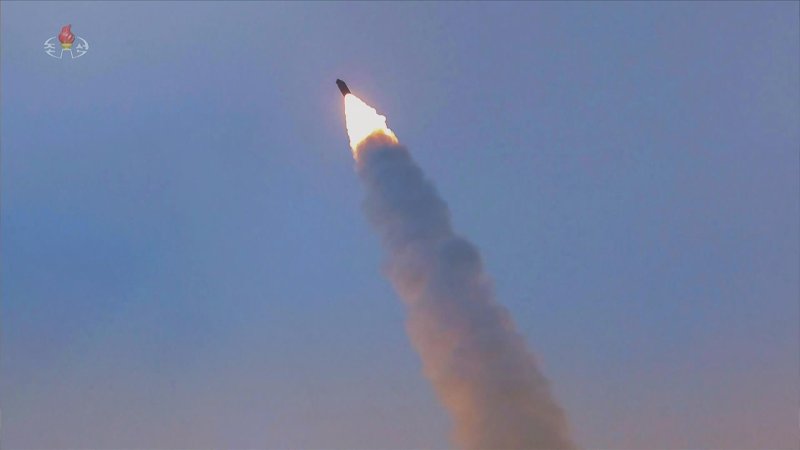
The ROK JCS said on the 19th that it detected several unidentified ballistic missiles fired from the Sinpo area of North Korea into the East Sea around 6:10 a.m. South Korean forces are strengthening surveillance and readiness in preparation for additional launches. They are also closely sharing related information under trilateral ROK-U.S.-Japan cooperation and maintaining full readiness.
The latest provocation is seen as a move tied to the situation surrounding President of the United States Donald Trump's planned visit to China next month and the war in the Middle East. In particular, analysts say it appears to be a calculated show of force aimed at influencing the U.S.-China Summit, where the Korean Peninsula issue is likely to be discussed as a key agenda item between Trump and Xi Jinping, President of China.
Tensions around the Strait of Hormuz are also cited as a major backdrop. The launch is being interpreted as part of a psychological operation intended to increase strategic pressure on the United States while the attention of the Western world is focused on the Middle East.
It is also possible that the move is linked to the development of what North Korea calls its 'important weapons systems,' including cluster warheads, electromagnetic weapons systems, and carbon-fiber dummy munitions, which it has recently been testing in succession.
North Korea fired an unidentified projectile on the 7th, but it was believed to have disappeared after showing signs of abnormality shortly after launch. The following morning, on the 8th, it fired several SRBMs into the East Sea, and later that afternoon it launched one more SRBM that flew more than 700 kilometers.
North Korean state media later said the launch was a test of the destructive power of the new Hwasong-11Ga short-range ballistic missile equipped with cluster bombs. According to the report, the Missile General Bureau claimed that the test conducted in the Wonsan area confirmed the missile's ability to devastate a target area of 6.5 to 7 hectares, or about 20,000 pyeong, with extremely high density. The test was seen as a display of power, with hundreds of submunitions separated from a single warhead raining down over a wide area.
By combining tests of new weapons with ballistic missile provocations, North Korea is expected to continue a calculated campaign aimed at testing South Korea's immediate response posture and highlighting its presence ahead of the U.S.-China Summit.
Meanwhile, this launch was counted as North Korea's seventh ballistic missile provocation this year, including those on January 4, January 27, and March 14.
<Timeline of North Korea's 2026 ballistic missile provocations>
- January 4: Fired from the Pyongyang area into the East Sea (first provocation of the year)
- January 27: Fired several missiles from the northern Pyongyang area
- March 14: Fired more than 10 missiles in a salvo from the Sunan area
- April 7: Fired from the Pyongyang area, but the projectile disappeared early in flight (analyzed as a failure)
- April 8 (morning): Fired several SRBMs from the Wonsan area
- April 8 (afternoon): Fired one additional missile from the Wonsan area (Hwasong-11Ga cluster-bomb test)
- April 19 (today): Fired several unidentified ballistic missiles into the East Sea
[email protected] Lee Jong-yoon Reporter