"I’m More Afraid of Missing Out Than of a Bull Market": Retail Investors Caught in Another FOMO Wave, Driving Margin Debt to a Record High
- Input
- 2026-04-17 17:32:08
- Updated
- 2026-04-17 17:32:08
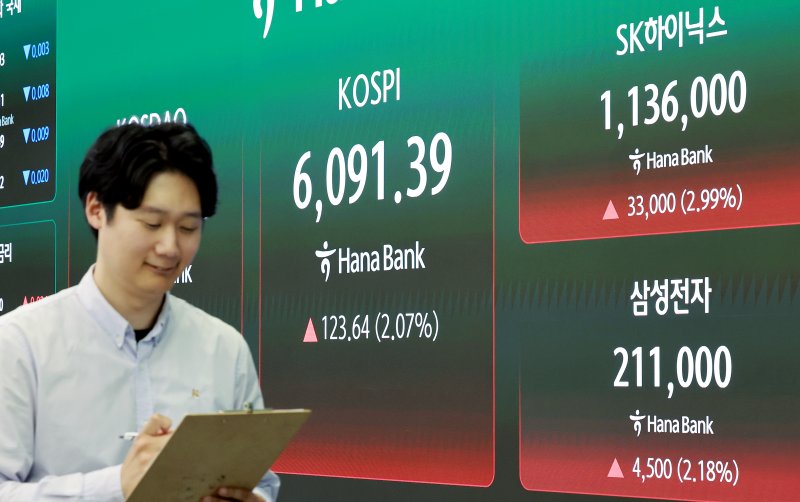
[Financial News] As hopes rise for renewed talks between the United States of America (the U.S.) and Iran, money that had been held back is flowing into the domestic stock market. Cash waiting on the sidelines has quickly returned to near prewar levels, and FOMO, or the fear of missing out on a rally, is spreading. As a result, the amount of borrowed money used to buy stocks has also surged to an all-time high.
Deposits hit a three-week high... More than 10 trillion won added in six trading days after ceasefire news
According to the Korea Financial Investment Association (KOFIA) on the 17th, investor deposits stood at 117.6724 trillion won as of the 14th. That was the highest level in about three weeks, since April 24. Deposits, which had plunged to the 107 trillion won range on the 6th, just after the war began, jumped by more than 10 trillion won in only six trading days after news of a two-week ceasefire between the U.S. and Iran. Even though ceasefire talks collapsed over the weekend, both sides have shown no sign of backing away from renewed negotiations, and the market appears firmly inclined to view geopolitical risk as easing.
Leveraged funds are also pouring in quickly. As of the 14th, the balance of margin loans had reached 33.2824 trillion won, nearing an all-time high. In the KOSPI Composite Index market alone, the figure hit a record 23.0406 trillion won. Funds have been especially concentrated in semiconductor blue chips that are driving the index higher, with margin balances for Samsung Electronics and SK hynix rising by 107% and more than 30%, respectively, from the end of last year.
Brokerages that had tightened margin trading amid recent volatility are now reopening services one after another, further fueling the inflow of money. Following NH Investment & Securities, Hana Securities, KB Securities, which expanded its limit, and Hanyang Securities, which cut interest rates, have also launched aggressive sales efforts.
Leveraged investing can trigger forced selling in a downturn, creating a vicious cycle of cascading declines
The problem is that leveraged money chasing short-term gains can become a market flashpoint. Margin trading can maximize profits in a rising market, but if a stock falls below a certain level, the brokerage forcibly sells it at the lower limit in what is known as a "forced sale." That can set off a vicious cycle of cascading stock-price declines.
The Financial Supervisory Service (FSS) is concerned that the surge in leveraged investing could lead to forced selling. Speaking at a regular press briefing at the FSS headquarters in Yeouido, Seoul, on March 26, Lee Chan-jin, Governor of the FSS, said, "Unlike other generations, young people in their 20s and 30s are increasingly suffering financial shocks from borrowed-money investing, and that is regrettable." He added, "Even in good markets, there are many cases where investors make little profit, and there are also quite a few who are caught off guard by forced selling."
Lee also warned, "When you invest with borrowed money, you cannot hold for the long term. In a volatile market, if a stock drops sharply even once, forced selling can be triggered and losses can occur." He added, "If this repeats, it could lead to very serious damage."
Meanwhile, according to the Korea Exchange (KRX) on the 17th, the KOSPI Composite Index closed at 6,191.92, down 34.13 points, or 0.55%, from the previous session. It briefly rose as high as 6,230.32 during the day, but gave up some gains as short-term profit-taking orders flooded in.
[email protected] Seong Min-seo Reporter