Even With "540 Million Won Per Person" on the Table...Union Warns "A General Strike at Samsung Could Cost 30 Trillion Won"
- Input
- 2026-04-17 14:33:30
- Updated
- 2026-04-17 14:33:30
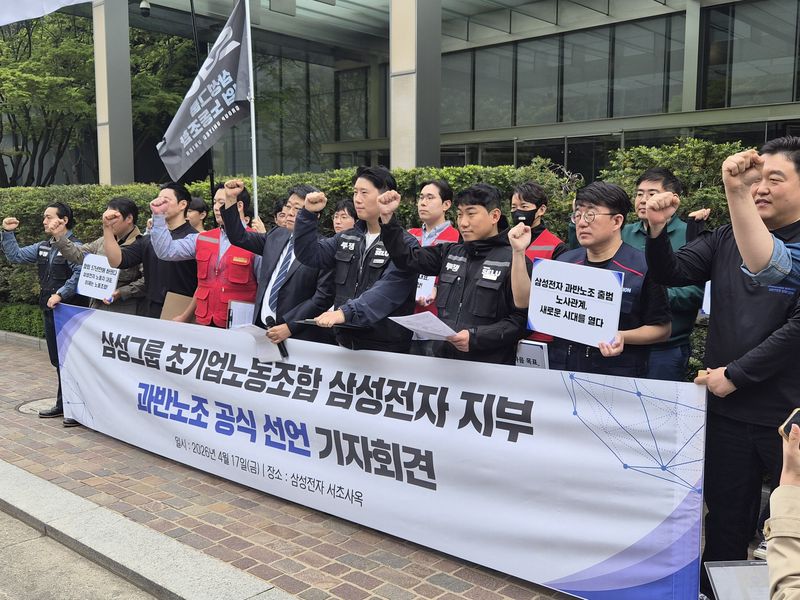
Financial News reports that Samsung Electronics Co., Ltd. has, for the first time since its founding, seen the launch of a majority labor union, which has now declared a general strike. Concerns are mounting that this could lead to production disruptions worth up to 30 trillion won. Analysts warn that, amid intensifying global competition in semiconductors, the company faces not only financial losses from halted production but also a serious blow to customer trust.
On the 17th, the Samsung Electronics Branch of the National Samsung Group Supra-Enterprise Labor Union held a press conference in front of the Seocho office building and formally announced that it had secured a majority of union members.
Choi Seung-ho, head of the Samsung Electronics Branch of the National Samsung Group Supra-Enterprise Labor Union, stated, "We will go through the Ministry of Employment and Labor (MOEL) verification process to obtain legal status as the workers’ representative." He then outlined three main goals: blocking unfavorable changes to work rules, forming a labor-management council centered on union members, and improving treatment through stronger bargaining power. Addressing Lee Jae-yong, Chairman of Samsung Electronics, he added, "As the legal representative of the workers, I demand that the chairman engage in direct talks."
A majority union is a labor union that organizes more than half of all employees and has the authority to directly agree with management on key working conditions, such as changes to work rules and working-hour systems. This is the first time a majority union has emerged at Samsung Electronics.
The union has made reform of the performance-based bonus system its core demand. It is proposing to allocate 15% of operating profit as the bonus pool, to be distributed 70% based on division performance and 30% based on business unit performance. The aim is to move away from one-off rewards and establish a structured, institutionalized performance bonus system.
The prospect of a general strike is increasingly becoming a reality. The union plans to kick off a large-scale rally at the Samsung Electronics Pyeongtaek Plant on April 23, then push ahead with a general strike for about 18 days from May 21 to June 7. All worksites are expected to participate simultaneously, with a focus on the semiconductor-focused Device Solutions Division.
Industry observers estimate that if a general strike does take place, the resulting losses could reach tens of trillions of won. Given that Samsung Electronics’ monthly operating profit is around 30 trillion won, they calculate that even after factoring in backup capacity, the company could lose about 1 trillion won per day, or a total of 20 trillion to 30 trillion won over the full strike period.
In response, Samsung Electronics filed for an injunction the previous day with the Suwon District Court, seeking to prohibit what it calls illegal industrial action by the union. The application covers actions such as obstructing the operation of safety and protective facilities, halting work to prevent equipment damage and raw material or product spoilage, occupying production lines, and coercing participation in industrial action through threats.
This move is seen as a preemptive step to minimize the impact a general strike could have on semiconductor production lines. Analysts note that if production disruptions materialize, damage to market share and customer trust will be unavoidable.
Branch Chief Choi commented, "Because the rally on the 23rd is scheduled for just one day, there will be no production disruption," adding, "If necessary, it is possible to arrange work mainly with non-union employees, and if the company requests cooperation, the union will also cooperate."
Meanwhile, the size of the Samsung Electronics union has been expanding rapidly. Membership surpassed 63,000 in January this year, exceeded 70,000 by the end of March, and as of today has grown to more than 75,000. This is more than half of the company’s roughly 128,000 employees.
[email protected] Lee Dong-hyuk Reporter