Has the Samsung–SK hynix rally gone too far? "Market cap needs to reach 1,000 trillion won and beyond; still undervalued"
- Input
- 2026-04-17 09:24:55
- Updated
- 2026-04-17 09:24:55
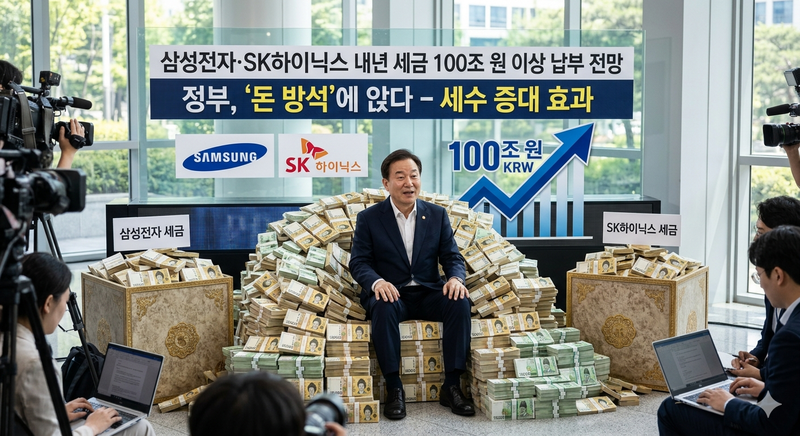
[Financial News] The combined market capitalization of Samsung Electronics and SK hynix has rebounded to record highs and surpassed 2,000 trillion won, yet some analysts still see the stocks as undervalued.
According to the Korea Exchange (KRX) on the 17th, as of the closing price on the 16th, Samsung Electronics and SK hynix had market capitalizations of 1,271 trillion won and 823 trillion won, respectively. Together, their combined market cap reached 2,094 trillion won.
However, Kim Dong-won, an analyst at KB Securities, argued that the fair value of their combined market capitalization should be more than 3,300 trillion won. He pointed out that, given their earnings growth, the two companies are currently trading at an excessive discount.
KB Securities estimates that this year Samsung Electronics and SK hynix will generate a combined operating profit of 586 trillion won. This is projected to be about five times higher than the operating profit of Taiwan Semiconductor Manufacturing Company (TSMC), estimated at 129 trillion won. Even so, their combined market cap is expected to stand at 2,214 trillion won, far below TSMC’s 2,869 trillion won.
Kim said, "Samsung Electronics and SK hynix appear to be in a zone of excessive discount," adding, "Considering the pace and scale of their earnings improvement, their appropriate market capitalizations would be at least 2,000 trillion won and 1,300 trillion won, respectively."
Looking ahead, as memory serves as a strategic asset for building artificial intelligence (AI) infrastructure over the next five years, the visibility of market cap expansion for Samsung Electronics and SK hynix is expected to keep improving.
Kim noted, "They are expanding long-term supply agreements (LTAs) of three to five years with cloud and graphics processing unit (GPU) companies," and emphasized, "This not only suggests a structurally prolonged shortage in memory supply, but also signals an evolution toward a TSMC-style foundry business model based on order-driven production."
He went on to say, "In particular, shifting memory semiconductors to a foundry-type business model will simultaneously reduce earnings volatility and enhance visibility on performance," adding, "By strengthening the stability of their profit structure, this will act as a driver for higher valuations going forward."
[email protected] Han Young-joon Reporter