Samsung Begins Mass Production at U.S. Taylor Fab, a Key Battleground for AI Chips [Samsung Foundry Takes Off]
- Input
- 2026-04-16 18:27:14
- Updated
- 2026-04-16 18:27:14
After dispatching an initial group from Korea last year to establish the early-stage process, the company has now decided to send a second wave of engineers responsible for verifying yield rates and handling mass production and quality control. Compared with earlier expectations that full-scale operations would start between the second half of this year and early next year, the schedule now appears to be moving faster. This is being interpreted as a shift from pilot production to an early mass-production regime.
As the first large-scale order for the Samsung Electronics' Taylor semiconductor foundry plant in Texas—Tesla’s artificial intelligence (AI chip) project worth about 23 trillion won—moves into the production phase, Samsung is expected to gain momentum in securing additional foundry customers in the United States.
According to the semiconductor industry on the 16th, Samsung Electronics, which had been sequentially dispatching engineers in charge of ultra-fine processes to the Taylor plant since last year, has recently expanded the scope to include personnel dedicated to mass production. The company has sent organizations responsible for core production functions such as process control, yield verification, and quality response. Additional mass-production staff are scheduled to relocate to the United States in September.
An internal source at Samsung Electronics said, "Core engineers in Korea who handle ultra-fine processes of 3 nanometers and below are moving to the Samsung Taylor Semiconductor Fab in the United States," adding, "These personnel transfers will continue through the third and fourth quarters of this year."
Engineers dispatched to the United States are managed on a one-year rotation basis. The initial group that handled the early setup is returning to Korea, while follow-up staff in charge of mass production are being sent to replace them. A semiconductor industry official explained, "It appears the plant is moving from the setup phase—building out the initial process—to the stage of yield checks and mass production," and added, "At this point, it can be seen that the factory has transitioned to actual product manufacturing."
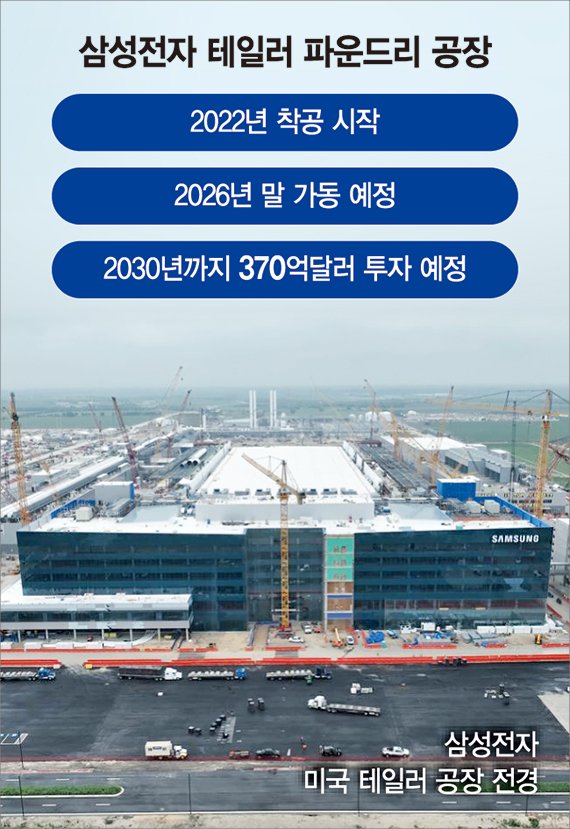
Samsung Electronics plans to invest 37 billion dollars (about 55 trillion won) to develop the Samsung Semiconductor Taylor Plant into a key production base for ultra-fine processes of 2 nanometers and below. Until the middle of last year, the plant had no major orders, forcing the company to delay the start of operations and even scale back some staffing. The situation changed dramatically, however, after Samsung signed a foundry contract worth 23 trillion won with Tesla.
At the Samsung Taylor Semiconductor Fab, Samsung Electronics plans to manufacture Tesla AI5 chip and Tesla AI6 chip using cutting-edge 2–3 nanometer-class processes. Elon Musk, Tesla Chief Executive Officer (CEO), also announced on his social media the previous day that the AI5 chip has completed tape-out. Tape-out means that the design of a semiconductor chip has been finalized and the project has moved into the prototype manufacturing stage.
Ahead of full-scale operations at the Samsung Semiconductor Taylor Plant, Samsung Electronics is also stepping up local hiring. According to the City of Taylor, Texas, the company plans to increase its local workforce to around 1,500 employees by the end of this year and then expand it to about 1,800, thereby establishing a full-fledged production system. Optimistic forecasts are emerging that the foundry business will soon break out of the red.
[email protected] Im Su-bin Reporter