Higher Yields and More Clients: Samsung Foundry’s Persistence Starts to Pay Off [Samsung Foundry’s Takeoff]
- Input
- 2026-04-16 18:25:04
- Updated
- 2026-04-16 18:25:04
■ 2027 seen as the first year of full-scale foundry growth
According to industry sources on the 16th, Samsung Electronics’ foundry division had 121 clients as of the end of last year, more than tripling from 35 in 2017. The business had long been mired in chronic losses, but the recent increase in orders and diversification of customers is gradually improving its earnings trajectory. Brokerages are also becoming more concrete in their outlook for a turnaround. Kiwoom Securities expects the non-memory segment, which includes Samsung Electronics’ foundry and System LSI Business Division, to post 30.1 trillion won in revenue and an operating loss of 3.6 trillion won this year, then swing to a profit in 2027 with 36.4 trillion won in revenue and 1.8 trillion won in operating profit. The foundry business is projected to play a major role in that shift.
Because of the nature of the foundry industry, there is a time lag between receiving an order and recognizing it as revenue. At last year’s shareholders’ meeting, Han Jinman, head of the foundry business at the Device Solutions (DS) Division of Samsung Electronics, explained, "Foundry is a contract-based business, so even if we secure an order now, it is recognized as revenue only after at least two years, and typically three years."
Even so, the pace of the rebound is picking up, and the business is expected to move from being a troubled unit that racks up multi-trillion-won losses to turning a profit by the end of this year or, at the latest, next year. Samsung Electronics has designated 2027 as the starting year for full-scale growth in its foundry business and plans to use advanced processes such as Gate-All-Around (GAA) to expand its market share.
The "System Semiconductor Vision 2030" announced by Samsung Electronics Chairman Lee Jae-yong in 2019 is also reinforcing this trend. Samsung Electronics has pledged to invest a total of 133 trillion won by 2030 to become the world’s No. 1 player in system semiconductors. The foundry business is regarded as a core pillar of the chairman’s mid- to long-term vision.
■ Narrowing the market-share gap with TSMC
Samsung Electronics has continued to invest steadily in its foundry business. Its foundry workforce has grown from about 13,000 employees in 2017 to roughly 21,000 recently, while its overseas headcount has nearly doubled from 3,000 to around 6,000. Technological competitiveness is also cited as a key driver of the anticipated earnings rebound. At this year’s shareholders’ meeting, one division head stressed, "Samsung Electronics is currently the only company mass-producing with GAA technology," adding, "Our most important goal this year is to rapidly raise yields and improve profitability."
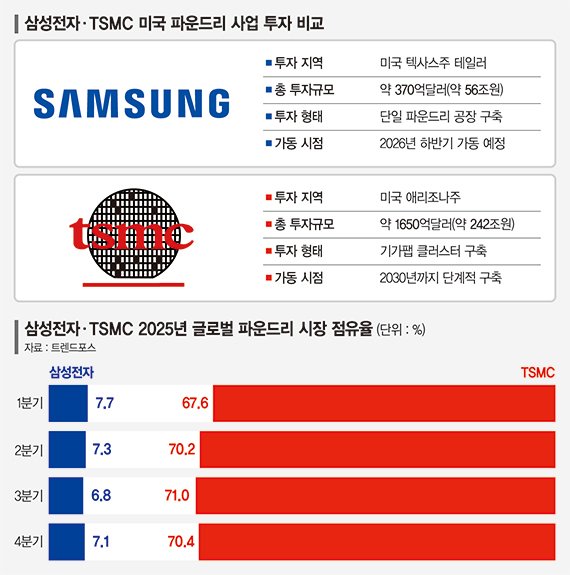
Industry observers say Samsung Electronics’ foundry market share is on a gradual upward trend, making its growth momentum more visible. According to market research firm TrendForce, Samsung’s global foundry market share rose from 6.8% in the third quarter of last year to 7.1% in the fourth quarter. The improvement in yields and process stability is seen as a key factor. Analysts note that securing large clients and accumulating mass-production experience could create a virtuous cycle that leads to additional orders.
Samsung Electronics has recently been broadening its customer base by winning more contracts, particularly from Big Tech companies. Last year, it signed a foundry contract worth about 23 trillion won with Tesla for AI chip production. These chips are scheduled to go into mass production using a 2-nanometer process at the Samsung Taylor semiconductor fabrication plant in Texas starting late this year.
Yields for ultra-fine processes are also improving rapidly. According to industry reports, Samsung Electronics has recently raised its yields to around 60%. Once yields surpass roughly 60%, cost savings begin to materialize in earnest, which can translate into stronger price competitiveness.
moving@fnnews.com Lee Dong-hyuk, Lim Su-bin, Kim Jun-seok Reporter