Capital gains tax surcharge bites: Gangnam and Seocho apartment prices fall 20% in a year
- Input
- 2026-04-16 18:18:19
- Updated
- 2026-04-16 18:18:19
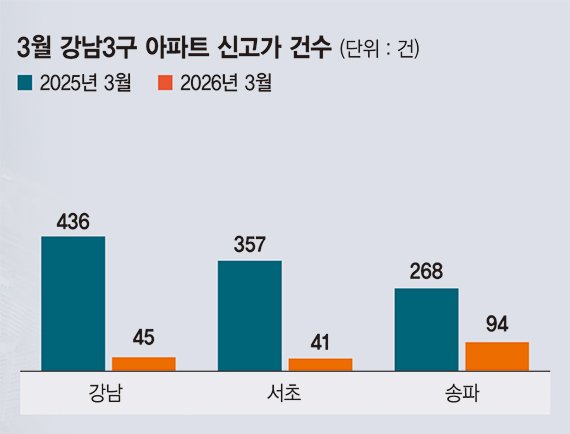
■ Record highs in the three Gangnam districts cut to one-sixth
According to the real estate industry on the 16th, there were 180 record-high apartment transactions reported in March this year in Gangnam, Seocho and Songpa. That is only about one-sixth of the 1,061 such deals recorded in the same month last year.
Gangnam District saw the steepest drop, with a decline of 89.7%. The number of record-high apartment transactions there fell from 436 to 45. Seocho District recorded an 88.5% decrease, from 357 to 41, while Songpa District saw a 64.9% drop, from 268 to 94.
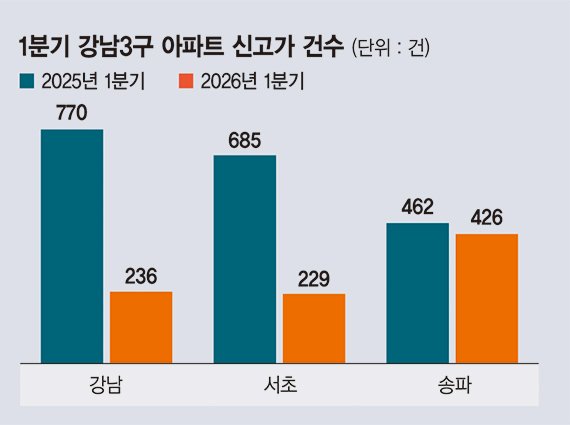
The trend of shrinking record-high prices remains clear even when looking at the first quarter as a whole. From January to March this year, the three Gangnam districts logged 891 record-high transactions, down by more than half from 1,917 in the first quarter of last year. Specifically, Gangnam District fell from 770 to 236, Seocho District from 685 to 229, and Songpa District from 462 to 426, declines of 69.4%, 66.6% and 7.8%, respectively. The main reason for this sharp drop in record-high deals in the three Gangnam districts is the reinstatement of the capital gains tax surcharge on multiple-home owners. Listings from owners burdened by higher taxes have effectively turned into fire sales, which has helped keep overall prices in check.
A more fundamental shift in the nature of buyers is another factor. Nam Hyuk-woo, a researcher at the Woori Bank WM Business Strategy Department, said, "If last year was a market where the Gangnam area kept rising while other regions were relatively left behind in a 'polarized, selective rally,' this year buyers without homes are the main players, and the market is moving to bring prices into line," adding, "In the current market, Gangnam has no room to flex its strength."
■ Top 10 apartment prices on a downward trend
In fact, average sale prices for high-end apartments show a downward trend in some areas. The average price of the top 10 apartment transactions in Gangnam District in March this year was about 5.97 billion won, down 21.7% from 7.62 billion won a year earlier. Under the same conditions, the average price of top apartments in Seocho District fell 22.1%, from 6.93 billion won to 5.4 billion won. Songpa District was the only one to see a slight increase, with the figure edging up from 3.84 billion won to 4.15 billion won.
The cutoff price for the "top 10" apartments in each district has also come down. In March last year, an apartment had to be worth at least 5 billion won to make the top 10, but this year the cutoff is in the 3 to 4 billion won range. Kim Deok-rye, Director of the Housing Research Office at the Housing Industry Research Institute, noted, "Gangnam is an area with high volatility," and analyzed, "In a situation of uncertainty involving the war between the United States and Iran and property taxes, more owners are putting their homes on the market, and as they rush to sell, the number of record-high transactions has naturally decreased."
However, it is unclear how long this pattern will last. Market participants predict that if the tax surcharge leads to a shortage of listings and transactions become more difficult, prices are likely to rebound. At the same time, they say the mood could shift depending on still-undecided government policies, such as how far to raise official land values or whether to increase property holding taxes. With President Lee Jae-myung having declared a strong commitment to normalizing the real estate market, additional policy measures could emerge.
[email protected] Kwon Jun-ho Reporter