Local Grant Tax Increased by 4 Trillion Won to Ease High Oil Price Support Burden on Local Governments
- Input
- 2026-04-16 18:12:57
- Updated
- 2026-04-16 18:12:57
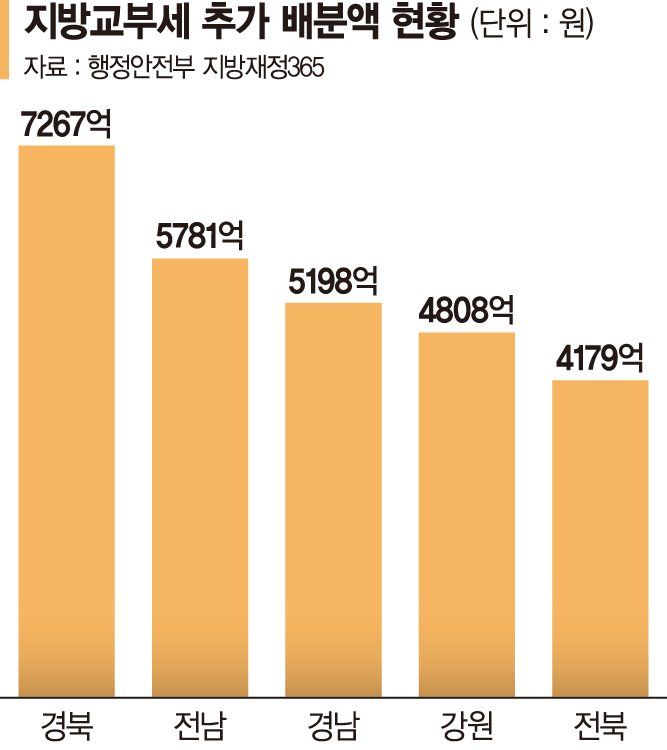
The Local Grant Tax is structured so that more funds go to fiscally weaker local governments, based on factors such as the share of basic livelihood recipients and whether an area is classified as a depopulated region. However, as the government expanded the supplementary budget, critics have warned that the financial burden on local governments would rise, sparking controversy.
According to data published on April 16 on Local Finance 365, operated by the Ministry of the Interior and Safety (MOIS), the total additional Local Grant Tax to be distributed to local governments amounts to 4.539 trillion won. By region, North Gyeongsang Province will receive the largest share at 726.7 billion won, followed by South Jeolla Province with 578.1 billion won and South Gyeongsang Province with 519.8 billion won. Gangwon Province will receive 480.8 billion won, and North Jeolla Province 417.9 billion won.
Local governments are expected to use the increased Local Grant Tax to cover their share of the High Oil Price Damage Relief Fund included in the national supplementary budget, as well as for various independent projects. The total budget for the High Oil Price Damage Relief Fund program is about 6.1 trillion won, of which 4.8 trillion won comes from the central government and roughly 1.3 trillion won from local governments.
To support the 1.3 trillion won in local matching funds, the government decided to increase the Local Grant Tax by a total of 4.53 trillion won and distribute it to local governments. As a result, local governments will not only avoid additional financial strain but will in fact be left with surplus funds.
By contrast, during last year’s Consumption Coupon program, local governments faced a much heavier burden. They had to restructure their own projects and even issue local bonds to finance the support, which significantly increased their fiscal pressure. This makes the current supplementary budget situation fundamentally different.
In particular, local tax revenues improved last year (2025), reaching 120.9 trillion won, up 6.8 trillion won from 114.1 trillion won the previous year. Against this backdrop, the government’s decision to further increase the Local Grant Tax to support local governments is seen as an effort to minimize their financial burden as much as possible.
An official from the Ministry of the Interior and Safety (MOIS) said, "The Local Grant Tax system is designed so that more funds go to local governments with weaker fiscal capacity and larger vulnerable populations," adding, "This additional round of Local Grant Tax will greatly help local governments implement the High Oil Price Damage Relief Fund program and execute their budgets."
MOIS stated that for 84 municipal and county governments designated as depopulated areas, the local share of the High Oil Price Damage Relief Fund is estimated at only about 4.4% of their increased Local Grant Tax. The ministry explained that, because the additional Local Grant Tax from excess tax revenue is being definitively allocated to each local government, the increase is effectively easing their fiscal burden.
MOIS plans to closely monitor local fiscal conditions and trends in supplementary budgets, while maintaining close communication with local governments. The ministry said it will do its utmost to ensure that the High Oil Price Damage Relief Fund is delivered to residents without delay.
[email protected] Kim Tae-kyung Reporter